
Load factor
Definition
Explanation
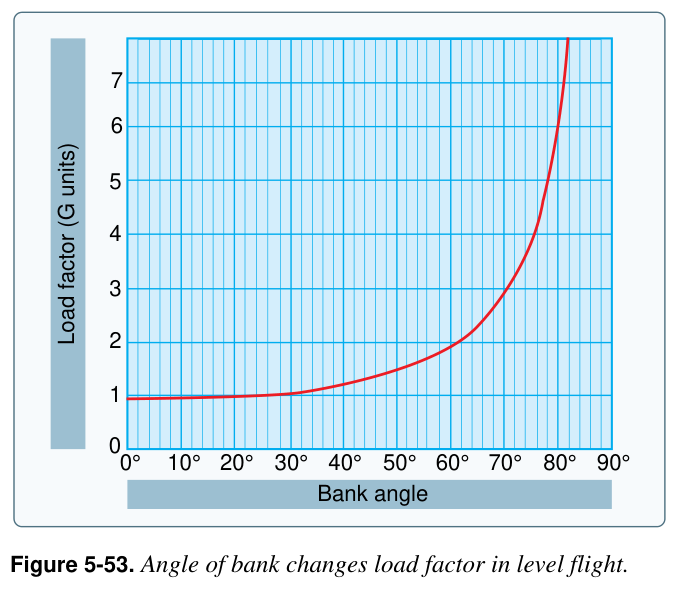
The wing must make lift equal to load factor × weight. Past about 45° the curve climbs fast — small increases in bank cost a lot of G.
Why it matters
I have students watch the G-feel and the back-pressure grow together as they roll into a steep turn — load factor is something you can feel, not just a number.
A DPE might ask
- What is the load factor in a level 60° banked turn?
- How does the wing's lift requirement change as you bank?
Definition
Explanation
The wing still stalls at its critical angle of attack; the load factor just makes you reach it at a higher airspeed. Maneuvering speed (Vₐ) is the speed at or below which the wing will stall before the airframe is overstressed — an abrupt full control input or a strong gust makes the wing stall instead of bending the airplane. Vₐ is lower when the airplane is lighter.
Why it matters
Students think load factor is an aerobatics-only concern. It isn't — a routine 60° steep turn already pulls 2 G, and any abrupt pull-up or turbulence adds load. That's why we respect maneuvering speed and don't yank the controls at high speed.
How much load factor does a level 60° banked turn produce?
At or below maneuvering speed, full or abrupt control inputs are protected by the wing stalling first. Above it, you can exceed the airplane's limit load — so slow to Vₐ in turbulence.
A DPE might ask
- What does maneuvering speed (Vₐ) protect against, and how does weight affect it?
- Why does stall speed increase in a steep turn?