
Gear, Brakes, Cabin & CO
Definition
Explanation
Tricycle gear places the center of gravity ahead of the mains, which makes the airplane stable on the ground and gives good forward visibility. Look at the nose gear and you'll find an oleo (air-over-oil) shock strut that absorbs shock, torque links that keep the wheel aligned with the strut as it extends and compresses, and a shimmy damper that stops the nosewheel from oscillating. What you won't find is a brake. And for all that hardware, the nose gear still isn't built to take the shock of a hard landing: touch down on the main wheels first and hold the nose off, because a nose-first arrival can bend the firewall or cause a propeller strike.
diagram: air.gearWhy it matters
On every landing, think 'mains, then nose.' Hold a little back-pressure after touchdown so the nosewheel settles gently instead of slamming down.
A DPE might ask
- What type of landing gear does your airplane have? Which wheels have brakes?
- What do the torque links and the shimmy damper on the nose gear do?
- Why do you touch down on the main wheels first?
Definition
Explanation
Brakes convert energy to heat, and heat is their enemy. Riding or dragging the brakes — resting your toes on them during taxi — overheats them, causing brake fade (reduced effectiveness) and rapid wear, and in the worst case a brake fire. Control your taxi speed with power first: reduce the throttle, let the airplane slow to a walk, and use short, positive brake applications rather than continuous pressure.
| Brakes | What to know |
|---|---|
| Disc brakes on the mains | Toe pressure at the top of the rudder pedals actuates hydraulic disc brakes on the main wheels. |
| Differential braking | Braking one side helps tighten a ground turn — essential with a free-castering nosewheel. |
| Don't ride or drag them | Constant light pressure overheats the brakes, causing fade and rapid wear. |
| Speed with power first | Set low power so the airplane taxis at a walk; use short brake applications, not continuous pressure. |
Why it matters
New pilots often taxi too fast and then ride the brakes to keep the speed in check. That heats the brakes and wears them out. Instead, set a low power so the airplane moves at a walking pace, and save the brakes for when you actually need them.
You're taxiing and find yourself constantly on the brakes to control speed. The better technique is:
A DPE might ask
- How do the brakes work in your airplane?
- What is differential braking, and when would you use it?
Definition
Explanation
Think of it as two separate paths. Exhaust gas runs inside the muffler and goes overboard out the tailpipe. Your cabin air passes around the outside of that muffler, picks up heat, and goes to the vents — it should never touch the exhaust gas at all. The only thing keeping those two paths apart is the muffler wall. So a cracked muffler, a leaking exhaust joint, or a failed shroud lets exhaust gas — which contains carbon monoxide — cross into the cabin-heat air and ride it straight to you. That's why the exhaust system gets inspected, and it's exactly why carbon monoxide is the next thing we cover.
diagram: air.cabin_heatWhy it matters
A DPE might ask
- Where does the cabin heat in your airplane come from?
- Why is a cracked exhaust a cabin-air concern?
Definition
Explanation
CO poisoning is insidious: the early symptoms — headache, drowsiness, dizziness, nausea, blurred vision, and impaired judgment — come on gradually and are easily blamed on fatigue or airsickness, so pilots keep flying while getting worse. Protect yourself two ways. First, carry a working CO detector; an electronic detector that alarms is far better than a chemical spot card, which fades over time and is easy to overlook. Second, know the response: if you suspect CO, turn the cabin heat OFF, open the fresh-air vents and a window, use supplemental oxygen if you have it, and land as soon as practical — then get medical attention, because CO stays in your blood for hours.
| Carbon monoxide | Detail |
|---|---|
| What it is | A colorless, odorless, tasteless gas from engine exhaust — you can't sense it directly. |
| How it gets in | Exhaust or heater leaks, worst with cabin heat ON; worse at altitude, where it compounds hypoxia. |
| Symptoms | Headache, drowsiness, dizziness, nausea, blurred vision, poor judgment — easy to mistake for fatigue. |
| Detector | Use an electronic CO detector that alarms; a chemical spot card fades and is easy to ignore. |
| Action Do this | Cabin heat OFF, fresh-air vents OPEN, oxygen if available, land soon, get medical attention. |
Why it matters
The classic, deadly mistake is attributing CO symptoms — headache, sluggishness, a little nausea — to being tired or a bumpy day, and pressing on. If you have a headache and don't feel right with the heat on, treat it as CO until proven otherwise: heat off, fresh air, and land.
On a cold flight with cabin heat on, you develop a headache, feel drowsy, and a bit nauseous. You should:
Buy an electronic CO detector and put it where you'll see it. The cardboard spot-dot detectors fade and are easy to ignore — an audible alarm is worth far more when the gas you're detecting gives no warning of its own.
A DPE might ask
- What are the sources and symptoms of carbon monoxide poisoning?
- What would you do if you suspected CO in the cabin?
Definition
Explanation
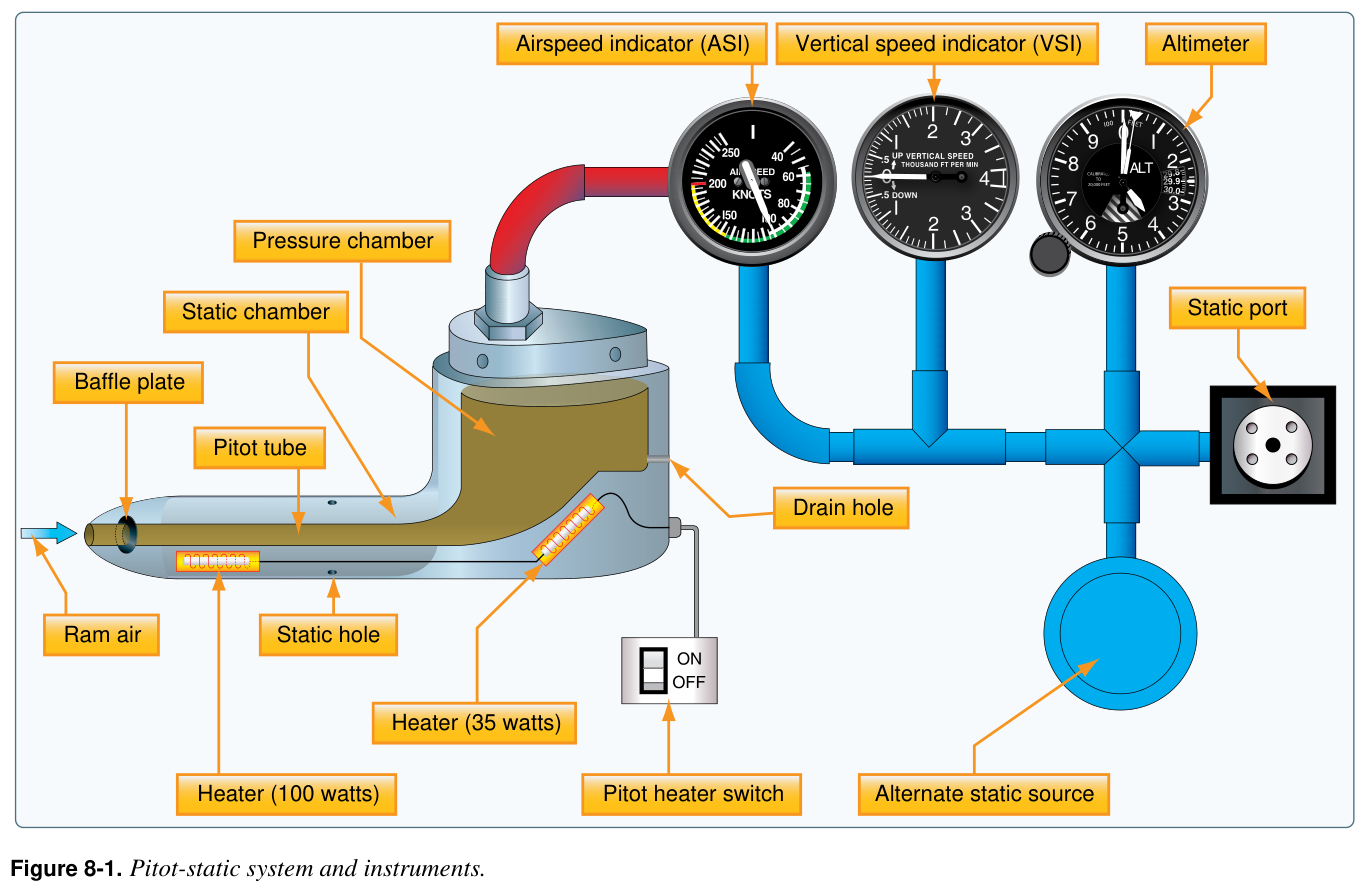
Ice, water, or even an insect can block the pitot tube and corrupt your airspeed indication, so turn pitot heat on when flying in visible moisture or icing conditions, or whenever your POH calls for it — and remember it's a real electrical load. On the ground, use a pitot cover to keep bugs and water out, and know where the drain holes are. Some airplanes have an alternate static source for when the normal port blocks. Exactly how a blocked pitot or static changes each instrument's reading is its own topic — you'll cover that in Module 4.
Why it matters
Make pitot heat part of your 'entering visible moisture' flow, the same way you think about carb heat. Turning it on after the tube ices is too late.
A DPE might ask
- What instruments does the pitot-static system feed?
- When do you use pitot heat, and why?
Definition
Explanation
Land on the mains and protect the nosewheel. Don't ride the brakes — control taxi speed with power. Suspect CO? Heat off, vents open, land. In visible moisture, pitot heat on before it ices. And when any question of limits or procedure comes up, the POH — not memory or habit — is the final word. That POH discipline is the whole subject of the next lesson.
| System | The one thing to do |
|---|---|
| Landing gear | Land on the mains; protect the nosewheel from a hard, nose-first arrival. |
| Brakes | Don't ride them — heat causes fade; control taxi speed with power first. |
| Cabin heat / CO | Suspect CO? Heat OFF, vents OPEN, land — then get checked out. |
| Pitot heat | In visible moisture or icing, pitot heat ON before the tube can freeze. |
| The authority | Your POH is the final word on every limit and procedure here. |
Why it matters
A DPE might ask
- Walk me through the abnormal you'd watch for in each of these systems.
- Where do you find the limits and procedures for all of them?