
Electrical system & avionics
Definition
Explanation
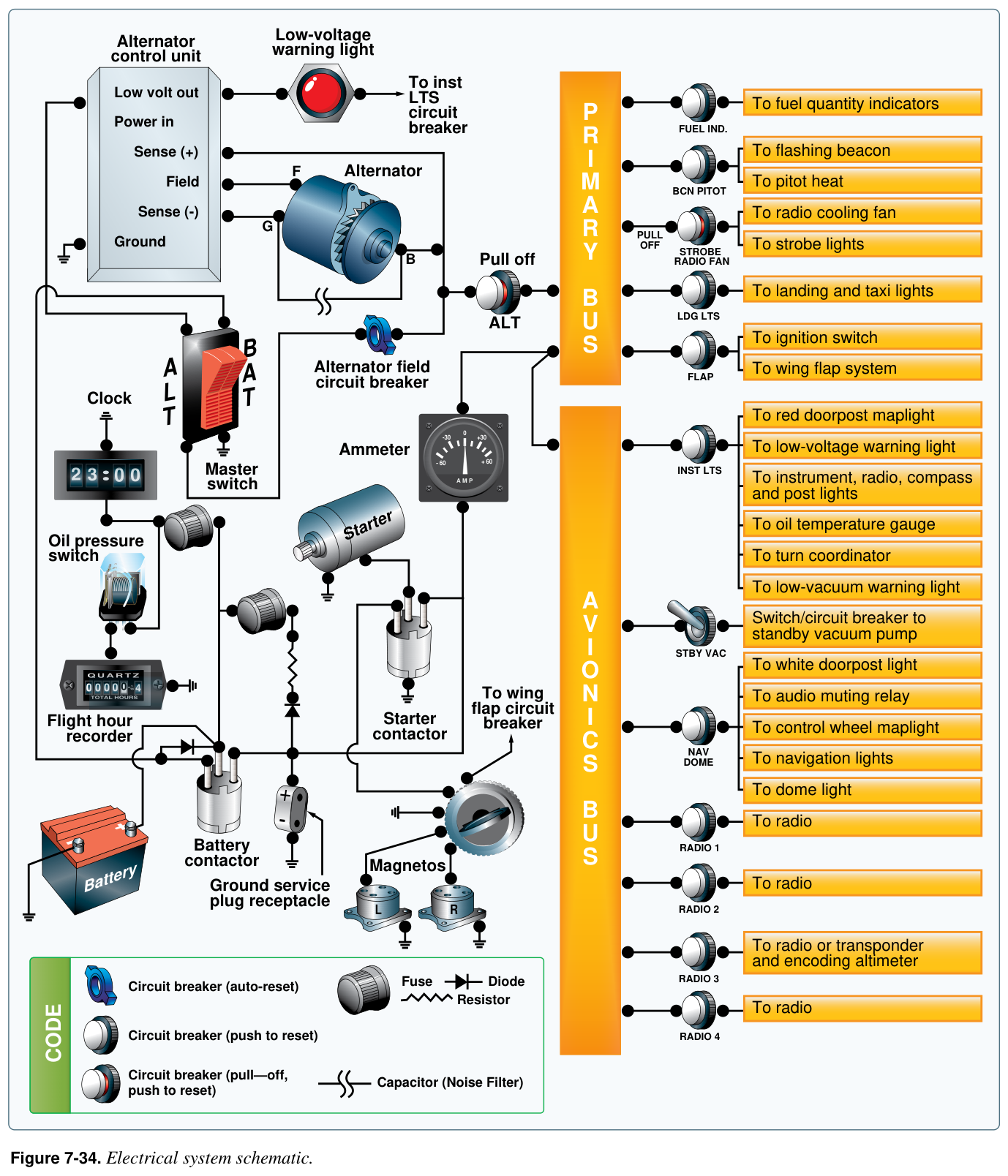
Think of it as a producer, a reserve, and a distribution network: the alternator produces, the battery stores and reserves, and the buses (with their circuit breakers) hand power out to the radios, lights, and other loads. Knowing your system voltage, alternator output, and battery is the baseline for understanding what a failure leaves you with.
Why it matters
Ask, for your airplane: if the alternator fails, what still works, and for how long on the battery? Knowing that before it happens turns a scramble into a plan.
A DPE might ask
- What supplies the airplane's electrical power in flight? What's the battery for?
- What is your system voltage and alternator output?
Definition
Explanation
The rectifier (a set of diodes) converts the AC to DC; the voltage regulator is the automatic control that keeps the charging voltage where it belongs as your RPM and loads change. Compared with an older generator, an alternator makes AC that's rectified to DC, produces its rated output even at low or idle RPM, and is lighter and more efficient. A generator makes DC directly but needs higher RPM to charge and is heavier, older technology.
Alternator
- Makes AC, rectified to DC by diodes
- Rated output even at low/idle RPM
- Lighter and more efficient
- The modern standard
Generator
- Makes DC directly
- Needs higher RPM to charge
- Heavier, older technology
- Found on some older airplanes
Why it matters
A DPE might ask
- The alternator produces AC — how does the airplane's DC system use it?
- What does the voltage regulator do? How does an alternator differ from a generator?
Definition
Explanation
A popped circuit breaker is a clue, not an invitation to keep resetting it — resetting into a fault can start a fire. The proper action is to reset it once, if the POH allows; if it pops again, leave it and manage without that circuit. Knowing which equipment lives on which bus tells you what you'll still have after an alternator failure.
| Buses & protection | Detail |
|---|---|
| Bus | A power 'highway' that distributes electricity to the equipment. |
| Circuit breaker / fuse | Protects the wiring and equipment from too much current. |
| Popped breaker | A clue, not an invitation to keep resetting. Reset once per the POH; if it pops again, leave it. |
| Know your buses | Which equipment survives an alternator failure, and for how long. |
Why it matters
It's tempting to keep resetting a breaker that won't stay in until it 'holds.' Don't. A breaker pops because too much current is flowing — often a fault. Reset it once if the POH permits; if it pops again, leave it off and fly without that circuit.
A circuit breaker pops in flight. What's the correct action?
A DPE might ask
- What is an electrical bus? What protects the circuits?
- What do you do if a circuit breaker pops in flight?
Definition
Explanation
Do the head-down work while stopped: programming, troubleshooting, and reading menus during taxi or on the takeoff roll are classic ways to lose situational awareness. Glass or round-dial, you remain the system integrator — the avionics serve your plan, not the other way around.
| Avionics | Detail |
|---|---|
| What they are | Radios, GPS, transponder, ADS-B, audio panel, autopilot, glass displays, engine monitors. |
| Benefit | Reduce workload and improve situational awareness. |
| Risk | Setup, database, and distraction errors — program and troubleshoot while stopped. |
| Know | What each item is powered by, and what you lose when a bus fails. |
Why it matters
Build your flows so the avionics are set before you move. If something needs reprogramming in flight, hand-fly or autopilot first, then look down — never both heads-down at once.
A DPE might ask
- What avionics does your airplane have, and what's each powered by?
- When should you program the GPS and avionics?
Definition
Explanation
The instinct to 'the battery will be okay' is wrong — think in minutes and amps. Turn off what you don't need (extra radios, lights you're not using, nonessential avionics) to stretch the reserve, keep what you need to navigate and communicate for the approach, and land before the battery runs down. Night or IMC makes this a different category of problem, because you depend on electrically powered lighting and instruments.
| Alternator failure | Indication → action |
|---|---|
| Low-voltage light / ammeter discharge | The alternator has failed — you're now on the battery. |
| Battery reserve | Minutes, not hours. Shed nonessential electrical load early. |
| Preserve essentials | Keep what you need to fly and land; make a conservative landing plan. |
| Night / IMC | A different category — you can lose lighting and instruments you depend on. |
Why it matters
A common mistake is assuming the battery will last a long time after the alternator fails. It won't — the usable reserve is typically minutes, and it drains faster the more you're running. Shed nonessential load immediately and plan to land soon, not eventually.
The low-voltage light illuminates and the ammeter shows a discharge. You should:
At night or in IMC, an alternator failure is urgent — you rely on electric lighting and instruments. Have a plan for which items you'd keep and where you'd land before it ever happens.
A DPE might ask
- How would you recognize an alternator failure? What would you do?
- How long does the battery last, and how do you make it stretch?
Definition
Explanation
Master off removes the power feeding the fire. From there you follow the POH: some procedures have you bring essential items back one at a time to find and isolate the faulted circuit, with fire extinguisher and ventilation steps as needed. The theme is the same — kill the source, control the smoke, and get on the ground.
| Electrical fire / smoke | Detail |
|---|---|
| Recognize | The smell of hot insulation or visible smoke — treat it as an emergency. |
| Remove the source | Turn the master switch off to kill the electrical power. |
| Isolate | Shed the offending circuits; ventilate per the POH. |
| Land | Follow the checklist and land — a fire outranks losing electrics. |
Why it matters
A DPE might ask
- What would you do if you smelled electrical smoke in flight?
- Why is turning the master switch off the first priority?