
Engine, propeller & ignition
Definition
Explanation
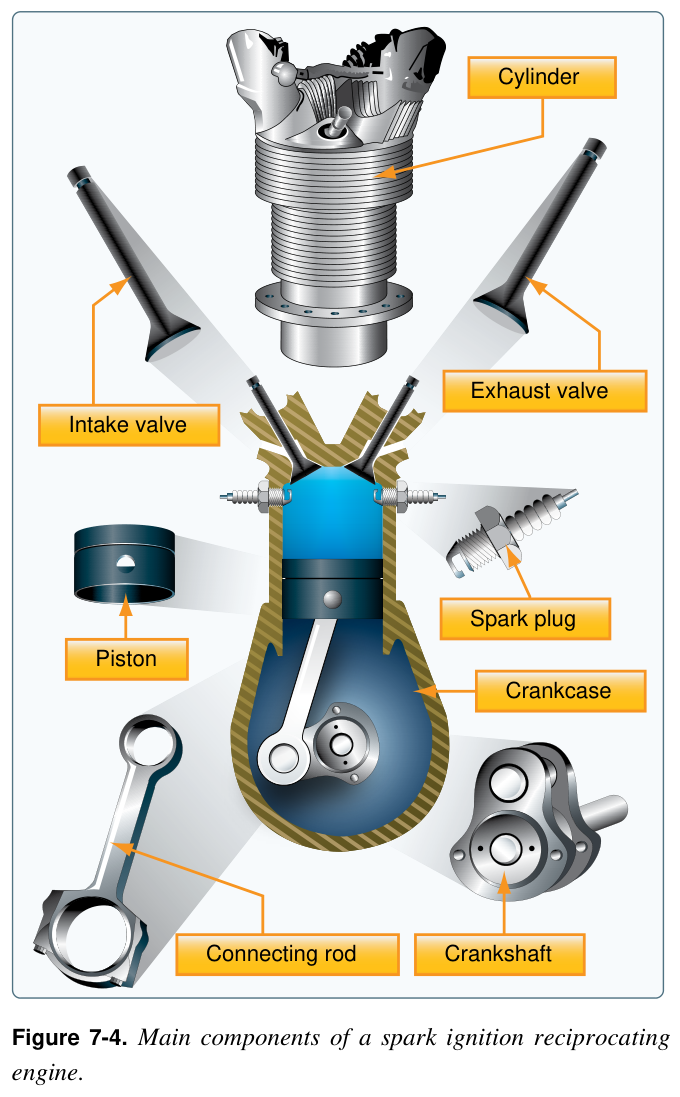
The engine turns fuel and air into rotation at the crankshaft, which spins the propeller. 'Horizontally opposed' describes the cylinder layout; 'four-stroke' describes how each cylinder makes power; 'air-cooled' and 'fuel-injected' (or carbureted) describe cooling and fuel delivery. Knowing your specific engine — and its normal oil, fuel, and temperature indications — is what lets you notice when something's wrong.
Why it matters
On an early lesson I have students recite their engine from memory — make, model, and what each part of the designation means. Filling this card in is the first step toward that.
A DPE might ask
- Describe your engine — make, model, and configuration.
- What does the designation (e.g. IO-360) tell you?
Definition
Explanation
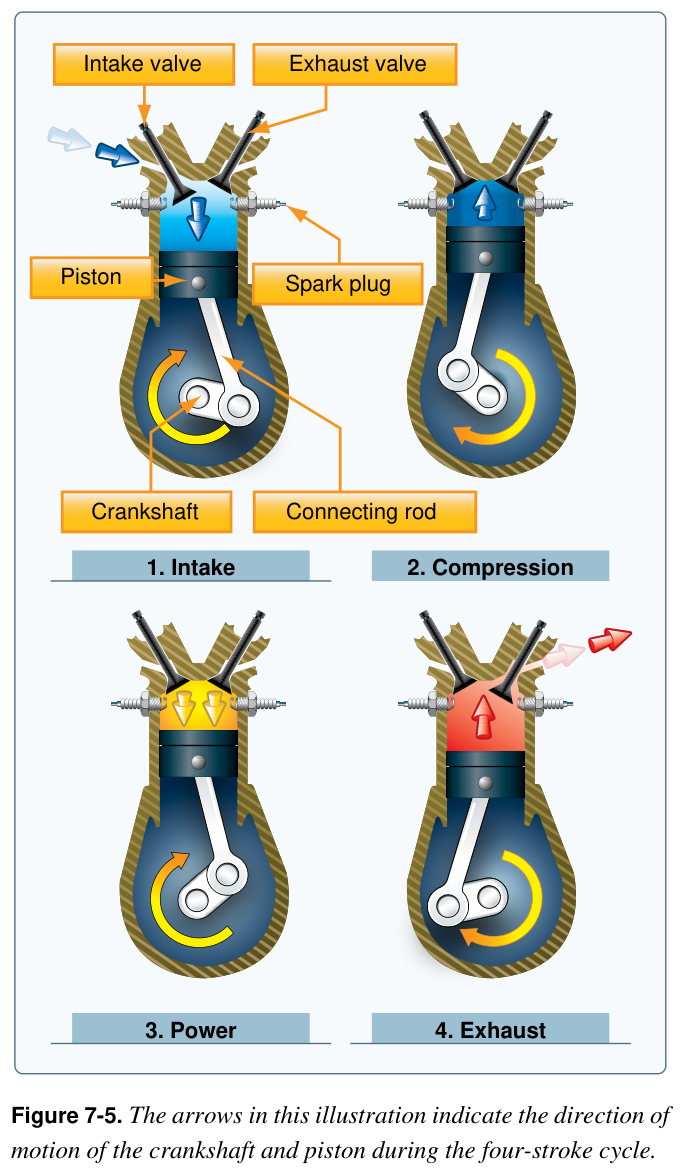
Only the power stroke makes power; the other three prepare for it or clean up after it. Both valves are closed during compression and power — that seal is what lets the mixture compress and burn. A four-cylinder engine staggers its cylinders so there's always a power stroke happening, which is what makes the power delivery smooth.
Why it matters
A DPE might ask
- What are the four strokes, in order?
- Which stroke actually produces power?
Definition
Explanation
The fix for both is similar: enrich the mixture (fuel cools), reduce power, open the cowl flaps and increase airspeed to improve cooling, and make sure you're using the correct fuel grade. The key distinction for the oral is the timing: detonation is an abnormal, explosive burn AFTER the spark; pre-ignition is ignition BEFORE the spark, from a hot spot.
Detonation
- The mixture explodes instead of burning smoothly
- Happens AFTER the spark
- Causes: low fuel grade, high power + poor cooling, too lean
- Fix: enrich, reduce power, open cowl flaps, increase airspeed, correct fuel
Pre-ignition
- The mixture ignites BEFORE the spark
- From a hot spot — a glowing deposit or cracked plug
- Sudden roughness, high CHT, power loss
- Fix: reduce power, enrich, cool the engine
Why it matters
Detonation and pre-ignition get swapped constantly. Anchor it on timing: detonation is the mixture EXPLODING after the normal spark; pre-ignition is the mixture igniting BEFORE the spark, from a hot spot. Detonation can lead to pre-ignition and vice versa, but the timing is what defines each.
The mixture ignites BEFORE the spark plug fires, set off by a glowing deposit. This is:
A DPE might ask
- What's the difference between detonation and pre-ignition?
- What would you do if you suspected detonation?
Definition
Explanation
With a fixed-pitch prop, one lever (the throttle) controls everything and RPM tracks power. With a constant-speed prop, the throttle sets manifold pressure and a second (prop) lever sets RPM; the governor does the rest. A high RPM is not automatically a high power setting — on a constant-speed airplane you read power from manifold pressure and RPM together.
Fixed-pitch
- Blade angle is fixed
- Simple — common in trainers
- RPM is your power reference
- One lever: throttle
Constant-speed
- A governor varies blade angle
- Holds the RPM you select
- Manage manifold pressure + RPM together
- Two levers: throttle + prop
Why it matters
A DPE might ask
- What's the difference between a fixed-pitch and constant-speed propeller?
- On a constant-speed airplane, how do you read power?
Definition
Explanation
Reading the mag check: a small RPM drop on each mag is normal (you've dropped one plug per cylinder, so the burn is slightly less efficient). If the engine QUITS on one mag, that magneto is dead — no-go, get maintenance. If there's NO RPM drop at all, the magneto isn't being grounded when you switch it off — usually a broken P-lead — which means that mag is HOT and live even with the switch off. Treat the propeller as live, and get maintenance before flying.
| Mag-check result | Meaning → what to do |
|---|---|
| Small RPM drop on each mag | Normal — both mags firing. Good within POH limits. |
| Engine quits on one mag | That magneto is dead — no-go, maintenance. |
| No RPM drop at all | Mag not grounded (broken P-lead) — hot/live. Treat the prop as live; no-go, maintenance. |
| Rough or excessive drop | Fouled plugs or a failing mag — troubleshoot per POH; maintenance if it persists. |
Why it matters
A no-RPM-drop mag check feels like good news — but it's the opposite. No drop means the switch isn't grounding that magneto (a broken P-lead), so the magneto is live even in the OFF position. The propeller must be treated as capable of firing. It's a maintenance no-go, not a pass.
During the mag check you get NO RPM drop on the right magneto. This means:
Always treat a propeller as if the mags are hot — never move or stand in the arc of a prop you wouldn't want to start. A broken P-lead makes that danger real even with the key off.
A DPE might ask
- Why does the airplane have two magnetos?
- What does a no-RPM-drop mag check tell you? What if the engine quits on one mag?
Definition
Explanation
Oil pressure dropping toward zero is an emergency — possible loss of lubrication: reduce power and land as soon as possible, prepared for the engine to fail. High oil pressure is usually just cold oil on a cold start and normalizes as it warms; if it's abnormal when warm, reduce power and monitor. Rising oil temperature calls for enriching, increasing airspeed, and reducing power — and high oil temp with low oil pressure together is serious, so land. For leaning, bring the mixture toward peak EGT, then enrichen to run rich of peak — this keeps cylinder temperatures down and preserves engine life.
| Indication | What a change means → action |
|---|---|
| Oil pressure drop / zero | Possible loss of lubrication — reduce power, land ASAP / prepare for engine failure. |
| Oil pressure high / spike | Often cold oil on a cold start (normalizes); if abnormal when warm, reduce power + monitor. |
| Oil temperature rising | Enrich, increase airspeed, reduce power; high oil temp with low oil pressure is serious — land. |
| EGT (leaning) | Lean toward peak EGT, then enrichen to run rich of peak to protect the engine. |
Why it matters
I teach leaning to peak EGT then enrichening to run rich of peak. It costs a little fuel economy versus lean-of-peak, but it keeps cylinder temperatures down and is the conservative choice for engine longevity in most trainers.
A DPE might ask
- How do you use the engine instruments to monitor the engine?
- What would you do if oil pressure dropped to zero? How do you lean?