
Fuel, oil, induction & cooling
Definition
Explanation
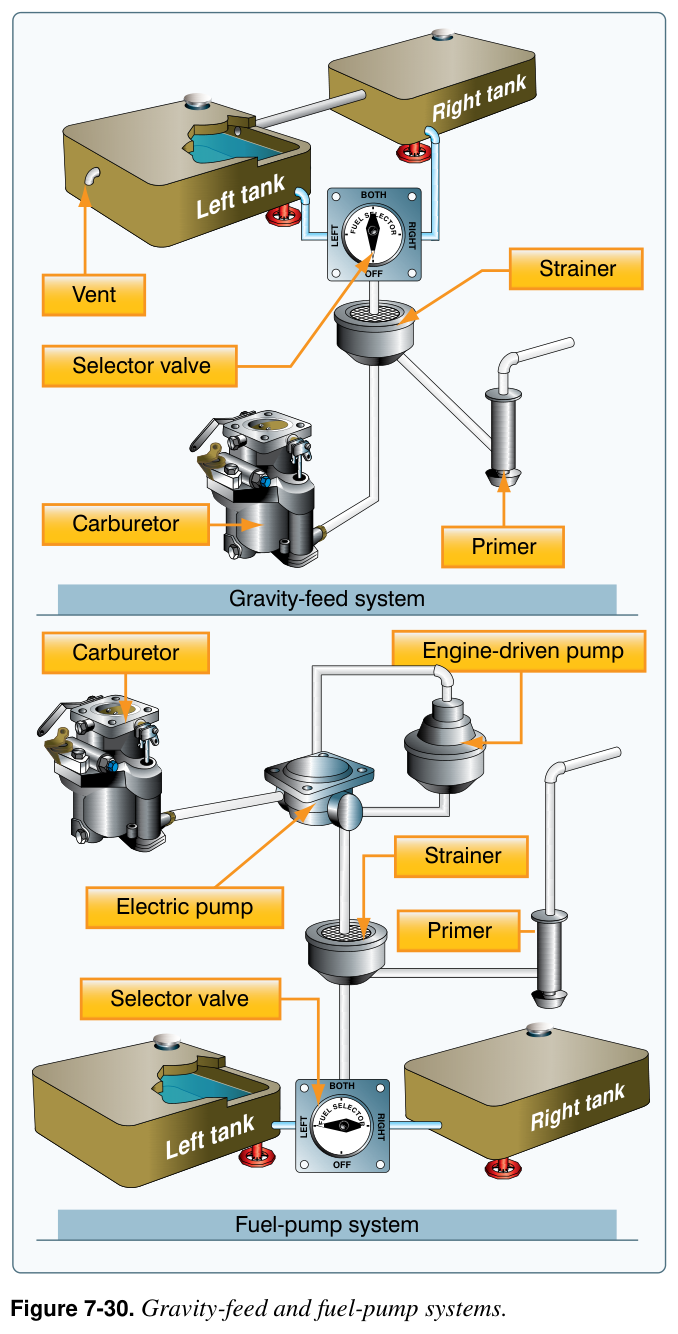
Know your airplane's fuel exactly: usable fuel (not total — some is unusable), the grade (100LL avgas is dyed blue), your selector logic (a high-wing 'BOTH' vs. a low-wing 'LEFT/RIGHT' that you must switch), and whether it gravity-feeds or needs a pump. These are the numbers a fuel-planning error turns into an emergency.
Why it matters
Learn your selector logic cold. On a low-wing airplane with no BOTH, running one tank dry while the other is full has caused countless 'engine failures' that were really a selector left in the wrong place.
A DPE might ask
- Trace the fuel from the tank to the engine.
- What is your usable fuel, grade, and selector logic?
Definition
Explanation
Water gets into tanks from condensation and rain; sumping until the sample is clear and the right color is a non-negotiable preflight item. The exhaustion-vs-starvation distinction matters because they have different fixes: exhaustion is a planning problem (verify quantity, plan reserves); starvation is a management problem (correct selector position, don't run a tank dry, use the boost pump per the POH).
| Fuel problem | What it is → what to do |
|---|---|
| Water / sediment | Water sinks below the fuel. Sump every drain before flight until the sample is clear and blue. |
| Wrong grade | Confirm the correct fuel (100LL avgas is blue). Never put jet fuel in a piston engine. |
| Fuel exhaustion | You ran out of fuel. Prevented by verifying quantity visually and planning reserves. |
| Fuel starvation | Fuel is on board but not reaching the engine — a selector on an empty tank or OFF, a blocked line, or vapor. Manage the selector; don't run a tank dry. |
Why it matters
Exhaustion and starvation get used interchangeably, but they're different failures. Fuel exhaustion means the tanks are empty — you're out of fuel. Fuel starvation means fuel is on board but isn't reaching the engine, most often because the selector is on an empty tank or OFF. One is fixed by fuel planning, the other by managing the selector.
The tanks still contain fuel, but the engine quit because the selector was on an empty tank. This is:
A DPE might ask
- What do you check for when you sump the fuel?
- What's the difference between fuel exhaustion and fuel starvation?
Definition
Explanation
Don't teach yourself a universal 'safe' oil quantity — the POH gives the real minimum, and your operator may set a higher practical one. Oil that's very low, very dark, or dropping between flights is telling you something. Pressure and temperature are the in-flight health signals: pressure that a system is producing flow, temperature about heat and cooling.
| Oil | Detail |
|---|---|
| Lubricates | Reduces friction between moving parts. |
| Cools | Carries heat away from the internal engine. |
| Cleans & seals | Carries contaminants to the filter; seals the piston rings. |
| Check | Quantity + condition per the POH; interpret oil pressure and temperature together. |
Why it matters
A DPE might ask
- What are the functions of engine oil?
- How do you check the oil, and what are you looking for?
Definition
Explanation
Carbureted systems are simpler and common in trainers, but they can form carburetor ice (next slide). Fuel-injected systems avoid that and distribute fuel more evenly, at the cost of a sometimes-fussier hot start. Either way, mixture management matters: too rich wastes fuel and fouls plugs; the leaning technique you learned in the engine lesson keeps it right.
Carbureted
- A carburetor mixes fuel and air
- Simple, common in trainers
- Susceptible to carburetor ice
- Has a carb-heat control
Fuel-injected
- Fuel metered to each cylinder
- More even fuel distribution
- Not susceptible to carb ice
- Can be harder to hot-start
Why it matters
A DPE might ask
- What's the difference between a carbureted and a fuel-injected engine?
- What does the mixture control do?
Definition
Explanation
Carb heat routes warm air into the carburetor to melt and prevent ice — it's an anti-ice system, not a warm-up knob. Apply FULL carb heat when you suspect ice: expect a small initial RPM drop (warm air is less dense), then rougher running as the melting ice passes through the engine, then a smoothing and RPM recovery as it clears. Fuel-injected engines don't have a carburetor and aren't susceptible.
| Carb ice | Detail |
|---|---|
| When | Cool, humid air — even on a warm day (roughly 20–70°F with moisture). The venturi cools sharply. |
| Symptoms | A gradual RPM drop (fixed-pitch) or manifold-pressure drop (constant-speed), then roughness. |
| What to do | Apply FULL carb heat. Expect an initial small drop, then rougher running as the ice clears, then smoothing. |
| Remember | Carb heat is an anti-ice system, not a warm-up knob. Fuel-injected engines aren't susceptible. |
Why it matters
Two mistakes: thinking carb ice only happens in freezing weather (it happens on warm, humid days), and pulling carb heat back off when the engine runs rougher after applying it. That rougher run is the melting ice passing through — keep the heat on until it clears and the RPM recovers.
You apply full carb heat for suspected carb ice and the engine runs rougher. You should:
If you fly a carbureted airplane, treat a slow, unexplained RPM loss as carb ice until proven otherwise — apply full carb heat early. Waiting until the engine is running badly makes it harder to clear.
A DPE might ask
- Under what conditions does carburetor ice form?
- What does carb heat do, and what do you expect when you apply it?
Definition
Explanation
You manage engine temperature with airspeed (more air = more cooling), power (less power = less heat), and cowl flaps if fitted. On the ground, point into the wind when practical and don't treat a long taxi or run-up as free warm-up. The exhaust's heat is also what warms the cabin — which is why a cracked exhaust is a carbon-monoxide concern (covered in the cabin lesson).
| Cooling & exhaust | Detail |
|---|---|
| Air-cooled | Baffles direct air over the finned cylinders to carry heat away — no radiator. |
| Cowl flaps | If fitted, open them to increase cooling (climb) and close to reduce drag (cruise). |
| Heat stress | High power, low airspeed, and hot days raise temperatures — manage with airspeed, power, cowl flaps. |
| Exhaust | Carries burned gases overboard. (Cabin-heat carbon-monoxide risk is covered in Gear, Brakes, Cabin & CO.) |
Why it matters
A DPE might ask
- How is the engine cooled, and how do you manage its temperature?
- What can cause high engine temperatures?