
The Magnetic Compass
Definition
Explanation
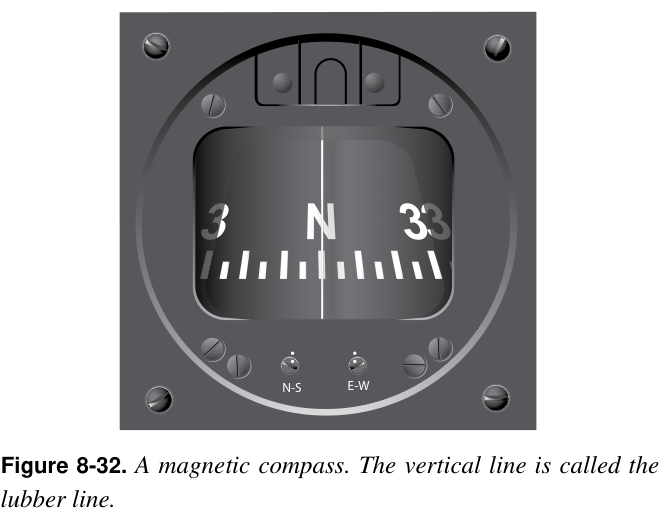
Because it's back-reading, with north at the lubber line, west sits where you'd expect east and vice-versa — the numbers decrease as you'd normally expect them to increase. The compass is simple and reliable, but it has a set of quirks and errors, and the way to remember them is the acronym DV MONA: Deviation, Variation, Magnetic dip, Oscillation, North turning error, and Acceleration error. The rest of this lesson walks each one.
Why it matters
Mnemonic
- D — Deviation
- V — Variation
- M — Magnetic dip
- O — Oscillation
- N — North turning error
- A — Acceleration error
The compass's quirks and errors, in order.
A DPE might ask
- How does the magnetic compass work, and what powers it?
- Why does the compass card read 'backwards'?
Definition
Explanation
Because deviation is specific to the airplane, every airplane has a compass correction card mounted by the compass that tells you what heading to steer for a given desired heading ('for N steer 003, for E steer 087…'). It's determined by 'swinging the compass' during maintenance. Deviation is the last step in the chain from true to compass heading: True, apply Variation to get Magnetic, apply Deviation to get Compass — TVMDC.
| Deviation (D) | Detail |
|---|---|
| What it is | The airplane's own magnetism — metal, motors, radios, and what's switched on — deflects the compass. |
| Unique to your airplane | It changes with the airplane and even with which electrical gear is on. |
| Correction card | A compass correction card by the compass tells you what to steer ("for N steer 003"). Set by swinging the compass in maintenance. |
| TVMDC | True → apply Variation → Magnetic → apply Deviation → Compass. |
Why it matters
A DPE might ask
- What causes compass deviation, and how is it corrected?
- Walk me through TVMDC.
Definition
Explanation
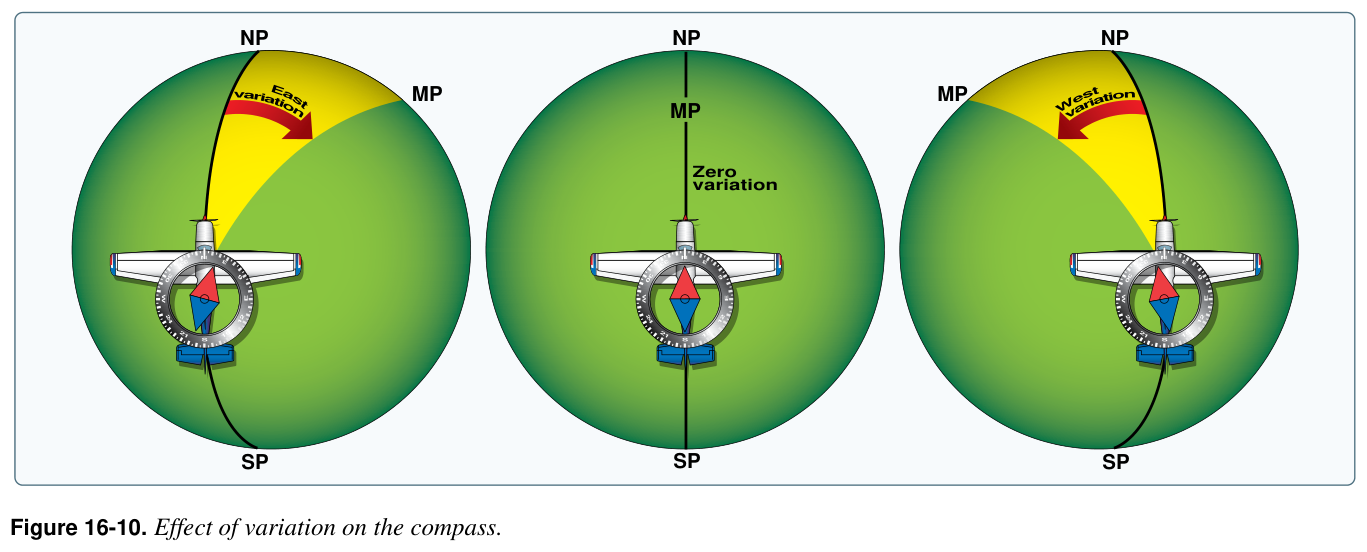
Your chart gives the variation for your area. To convert a true direction to a magnetic one, remember 'east is least, west is best': subtract easterly variation and add westerly variation. Variation is the V in TVMDC — you apply it to go from a true heading to a magnetic one.
Why it matters
A DPE might ask
- What is variation, and how does it differ from deviation?
- How do you apply easterly and westerly variation?
Definition
Explanation
You can't remove dip, but understanding it is what makes the turning and acceleration errors make sense — they're both the dipping card reacting to a turn or a speed change. Oscillation you handle by technique: in bumpy air the card swings back and forth, so average the swings and don't chase the needle.
| Magnetic dip & oscillation | Detail |
|---|---|
| Magnetic dip (M) | Away from the equator the Earth's field angles into the ground and pulls the card down on one side. |
| Why it matters | Dip is the root cause of the compass's dynamic errors — the turning and acceleration errors. |
| Oscillation (O) | The card swings erratically in turbulence. Average the swings — don't chase the needle. |
Why it matters
A DPE might ask
- What is magnetic dip, and what does it cause?
- How do you handle compass oscillation in turbulence?
Definition
Explanation
So you time your roll-out: when turning to a northerly heading, roll out early (undershoot the target) because the compass is lagging behind; when turning to a southerly heading, roll out late (overshoot) because it's leading. A useful rule of thumb for how much to lead the roll-out is about one-half your latitude plus 15°. The compass only reads correctly in straight-and-level, unaccelerated flight — which is exactly when you reset the heading indicator to it.
| North turning error (N) | Detail |
|---|---|
| Turning through north | The compass lags (and briefly indicates a turn the wrong way) — roll out early (undershoot). |
| Turning through south | The compass leads — roll out late (overshoot). |
| How much of an error | About one-half of your latitude, plus 15°. |
| When it's right | Only in straight-and-level, unaccelerated flight — which is when you reset the heading indicator to it. |
Why it matters
The classic mistake is rolling out of a turn exactly when the compass reads your target northerly heading. Because it lags on north, you'll roll out past your heading. Roll out early (undershoot) when turning to a northerly heading, and late (overshoot) when turning to a southerly one.
You're turning to a heading of north. To roll out on it using the compass, you should:
A DPE might ask
- Describe the northerly turning error and how you compensate.
- When is the magnetic compass accurate?
Definition
Explanation
The memory aid is that acceleration on an east/west heading gives a false turn toward the north, and deceleration gives a false turn toward the south — accelerate-north, decelerate-south. It's momentary: once you settle at a steady speed the error goes away. It's strongest on east/west headings and negligible on north/south ones. So don't reset the heading indicator or trust the compass in the middle of a speed change.
| Acceleration error (A) | Detail |
|---|---|
| On east/west headings | A speed change tips the dip-affected card, giving a false turn indication. |
| Accelerate → North | Speeding up shows a false turn toward north. |
| Decelerate → South | Slowing down shows a false turn toward south. |
| Momentary | It disappears at a steady speed, and is negligible on north/south headings. |
Why it matters
A common trap is trusting the compass right as you level off and add power (accelerating) on an easterly or westerly heading — it'll show a false turn toward the north. Wait until you're at a steady speed before you believe the compass or reset the heading indicator.
Flying east, you accelerate. The magnetic compass momentarily indicates:
A DPE might ask
- Describe the acceleration/deceleration error.
- On which headings is the acceleration error worst?