
Pitot-Static Instruments
Definition
Explanation
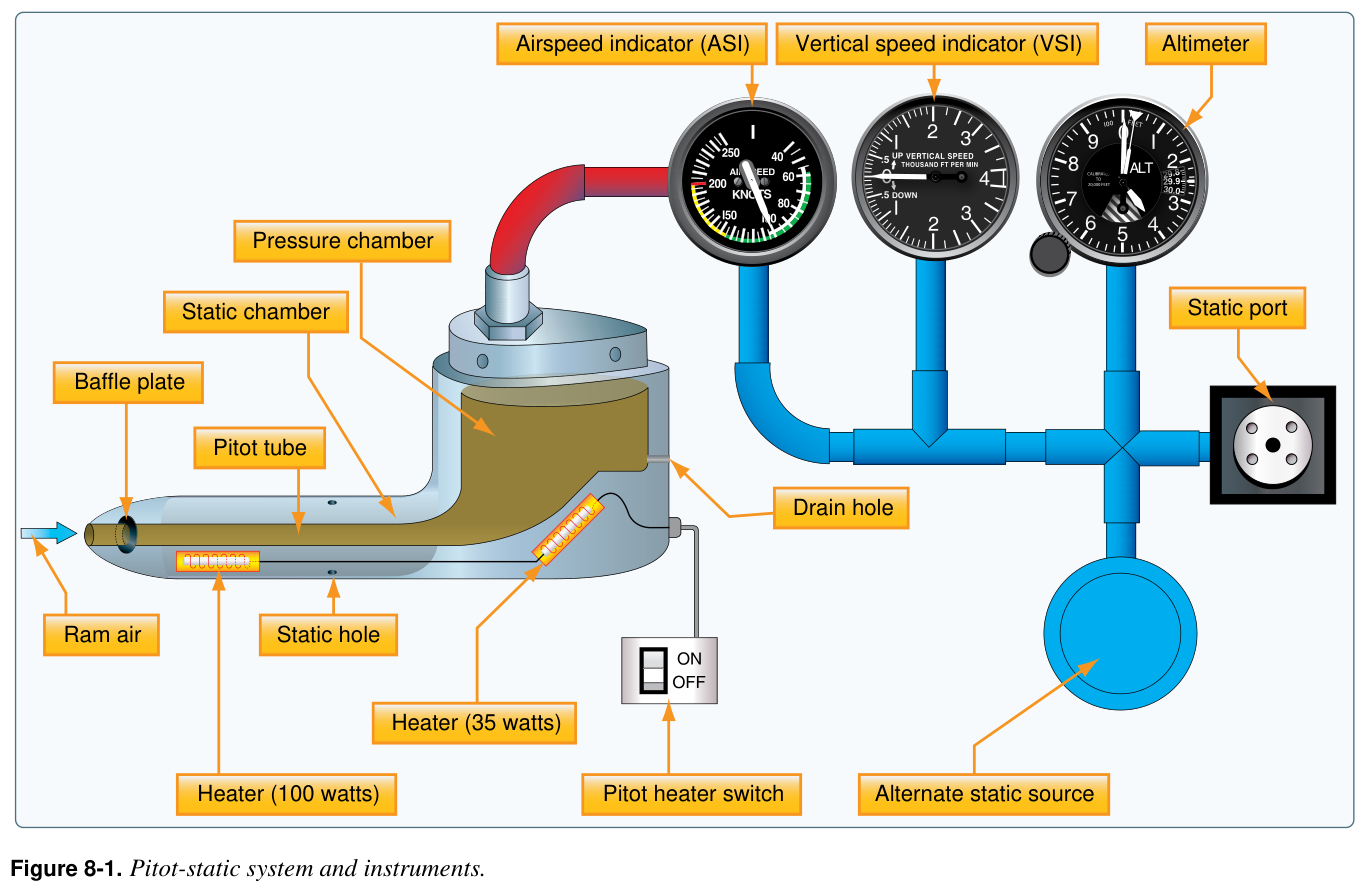
You already met this plumbing in Module 3 (the pitot-static system and pitot heat) and saw the airspeed arcs as limitations in the Regulations module. Here the focus is what each instrument does with the pressure: one instrument compares ram to static (airspeed), and two read static alone (altitude, and its rate of change).
Why it matters
A DPE might ask
- Which instruments are on the pitot-static system?
- Which pressures does each one use?
Definition
Explanation
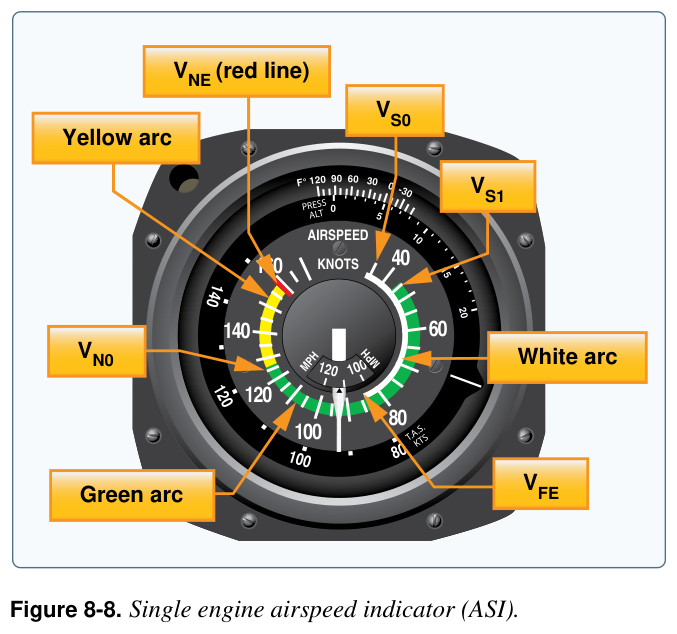
Several of the V-speeds are the color-arc endpoints you met in Regulations: Vso and Vs1 are the bottoms of the white and green arcs, Vfe the top of the white, Vno the top of the green, Vne the red line. Others — Vx, Vy, Va, Vg, Vr — aren't marked on the dial but are just as important to know cold. Your numbers live in Section 2 of your POH.
Why it matters
A DPE might ask
- What's the difference between indicated, calibrated, true, and ground speed?
- What are your airplane's Vx, Vy, Va, and best-glide speeds?
Definition
Explanation
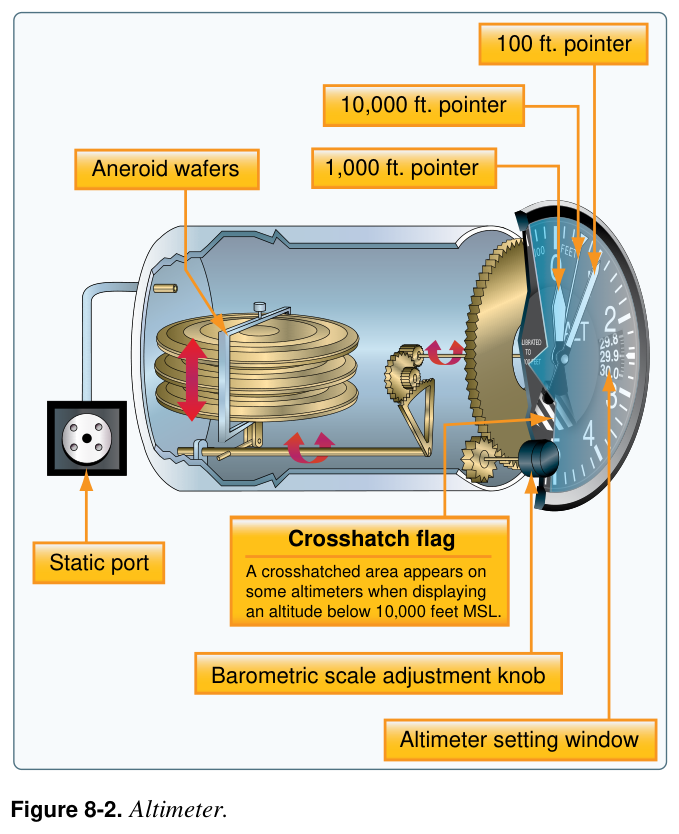
Know your altitudes: indicated (what you read on the current setting), pressure (what you read set to 29.92), density (pressure altitude corrected for temperature — the performance number), true (actual height above sea level), and absolute (height above the ground). And remember the trap: 'from high to low, look out below' — flying into lower pressure or colder air without resetting leaves your true altitude below what's indicated.
Why it matters
A classic mistake is flying a long way — especially into worsening weather or colder air — without updating the altimeter setting. As you fly from high pressure to low (or warm to cold) without resetting, your true altitude drops below what the altimeter shows. Update your setting regularly.
You fly toward an area of lower pressure without resetting the altimeter. Your true altitude is:
A DPE might ask
- How does the altimeter work, and what does the Kollsman window set?
- Define indicated, pressure, density, and true altitude.
Definition
Explanation
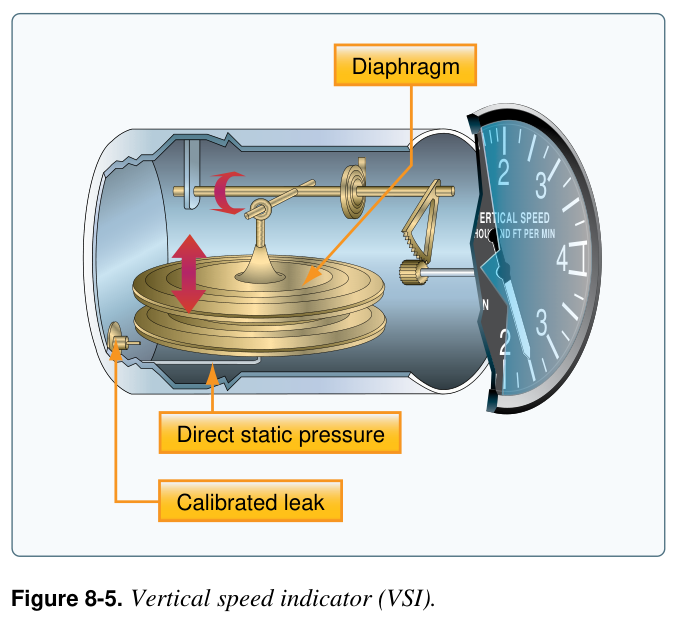
A basic VSI has a built-in lag of a few seconds — it needs a moment to catch up to a pitch change. It shows a trend immediately (the needle starts moving the right direction) and the accurate rate once things stabilize. An instantaneous VSI (IVSI) uses accelerometer pumps to reduce that lag.
Why it matters
A DPE might ask
- What does the VSI measure?
- Why does a basic VSI lag, and what's an IVSI?
Definition
Explanation
The fix for a static blockage is the alternate static source, which most airplanes have — it draws static pressure from inside the cabin. If you have no alternate source in an unpressurized airplane, breaking the glass of the VSI opens the system to cabin static (which reads slightly high because cabin pressure is a bit lower than outside). Know what your airplane has before you need it.
| Blockage | What happens |
|---|---|
| Pitot blocked, drain open | The airspeed indicator drops toward zero — no ram pressure reaches it. |
| Pitot & drain blocked (ice) | The airspeed acts like an altimeter — reads high in a climb, low in a descent. |
| Static blocked | The altimeter freezes at the blockage altitude, the VSI reads zero, and the airspeed reads low in a climb / high in a descent. |
| The fix Do this | Select the alternate static source. Unpressurized with no alternate, breaking the VSI glass gives cabin static (reads slightly high). |
Why it matters
The dangerous mistake is trusting an airspeed or altimeter that's behaving oddly instead of recognizing a blockage and cross-checking. If your static ports block, your altimeter and VSI go dead and your airspeed reads backward — select alternate static and fly pitch and power.
In flight the altimeter is stuck, the VSI reads zero, and the airspeed reads oddly. You should:
A DPE might ask
- What happens to each instrument if the static system blocks?
- What does a blocked pitot do, and how do you recover?
Definition
Explanation
Everything here comes back to the plumbing: what each instrument senses tells you both its normal reading and its failure mode. Fill in your V-speeds, keep the altimeter current, and know your alternate static source — those are the habits that make the pitot-static system a tool instead of a trap.
| Instrument | Senses / remember |
|---|---|
| Airspeed indicator | Ram minus static (dynamic pressure). IAS → CAS → TAS (≈2%/1,000 ft) → GS. |
| Altimeter | Static pressure. Set the Kollsman; know indicated / pressure / density / true / absolute. |
| VSI | Rate of static-pressure change (fpm), with a little lag. |
| When it blocks | Alternate static for a static blockage; a blocked-and-drained pitot reads like an altimeter. |
Why it matters
A DPE might ask
- Summarize what each pitot-static instrument senses.
- What are the airspeed and altitude types?