
Flying by the Instruments
Definition
Explanation
It helps to group the instruments by what they answer. The pitch instruments (attitude indicator, altimeter, airspeed, VSI) tell you whether the nose is where you want it. The bank instruments (attitude indicator, heading indicator, turn coordinator) tell you about the wings and heading. The power instruments are airspeed plus the tachometer or manifold pressure. The classic scan failures are fixation (locking onto one instrument), omission (skipping one), and emphasis (over-trusting one) — keep the scan moving.
| The scan | Instruments / technique |
|---|---|
| Cross-check | Continuously scan and compare — no single instrument tells the whole story. Keep returning to the attitude indicator (the hub). |
| Pitch group | Attitude indicator, altimeter, airspeed, VSI — is the nose where you want it? |
| Bank group | Attitude indicator, heading indicator, turn coordinator — where are the wings / heading? |
| Power group | Airspeed plus the tachometer / manifold pressure. |
| Scan errors | Fixation (staring at one), omission (skipping one), emphasis (over-trusting one). Keep the scan moving. |
Why it matters
A DPE might ask
- How do you scan the instruments, and how are they grouped?
- What are the common scan errors?
Definition
Explanation
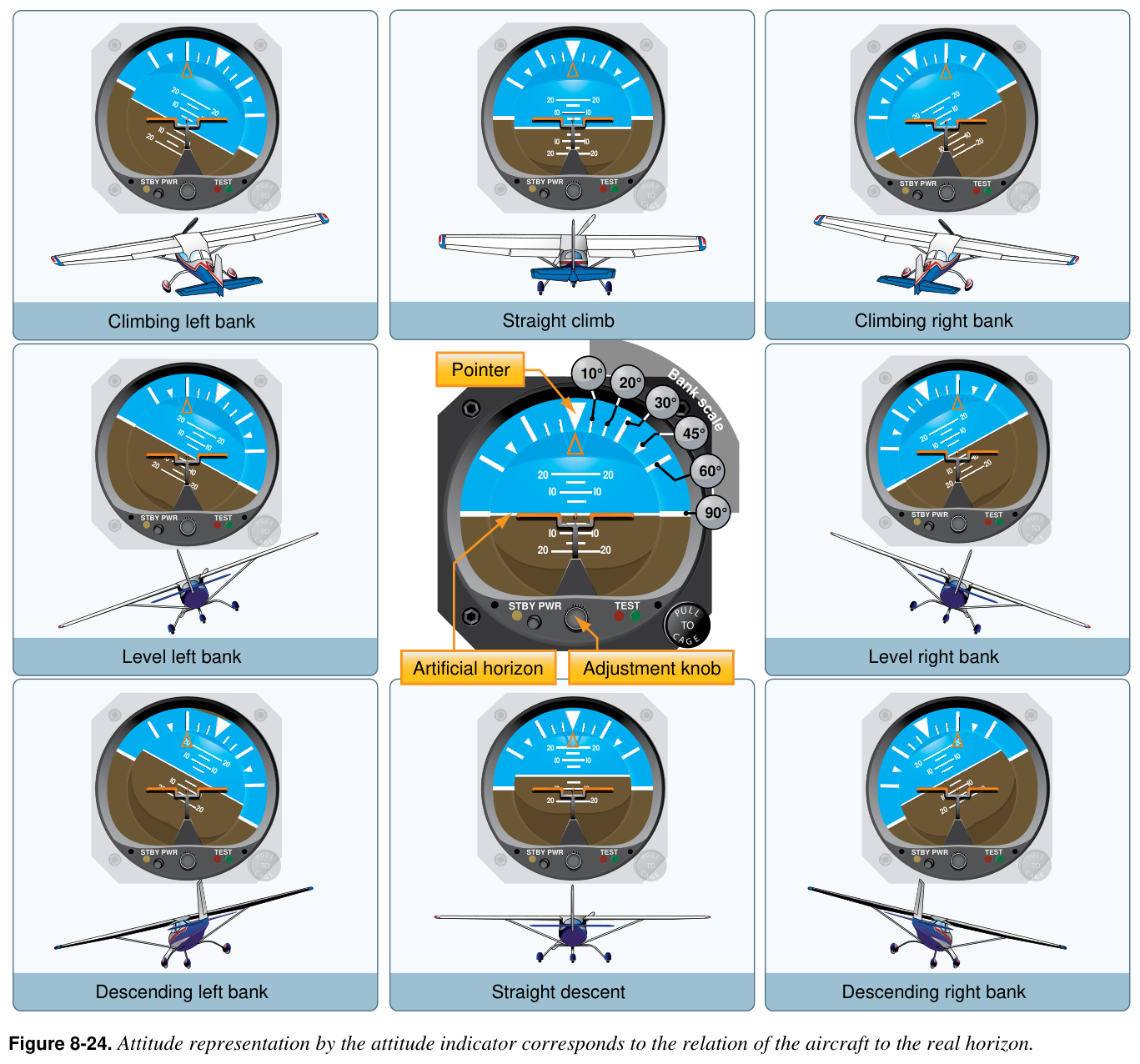
In a straight climb the miniature airplane sits above the horizon line; in a descent, below it. In a bank, the airplane tilts relative to the horizon and the bank pointer moves along the scale at the top. Because it shows pitch and bank together, the attitude indicator is the center of your scan — the instrument you interpret first and return to. This FAA figure shows what it looks like across the range of attitudes.
Why it matters
A DPE might ask
- What does the attitude indicator show, and why is it the master instrument?
- How does a climb, descent, or bank look on it?
Definition
Explanation
The common illusions: the leans (a slow roll goes unfelt, so rolling wings-level feels like a bank the other way); the graveyard spiral (the sense of turning fades in a prolonged turn, so you descend in a tightening spiral believing you're level); and the somatogravic illusion (acceleration feels like a nose-up pitch, deceleration like nose-down). The only defense is to trust the instruments over your body — believe the attitude indicator, not your gut.
| Spatial disorientation | What happens / the fix |
|---|---|
| Why it happens | With no outside horizon, your inner ear and body give false cues you cannot override by feel. |
| The leans | A slow roll goes unfelt; rolling wings-level then feels like a bank the other way — you feel like you're leaning. |
| Graveyard spiral | In a prolonged turn the sense of turning fades; you descend in a tightening spiral believing you're level. |
| Somatogravic illusion | Acceleration feels like a nose-up pitch (deceleration, nose-down) — tempting you to push or pull wrongly. |
| The fix | Trust the instruments, not your body. Believe the attitude indicator. |
Why it matters
A DPE might ask
- What is spatial disorientation, and name a few illusions.
- What's the only reliable defense against it?
Definition
Explanation
A vacuum failure is insidious: the AI and HI don't fail with a flag, they slowly wander off. Catch it by checking the suction gauge and by cross-checking a slowly-drifting AI or HI against the other instruments. Then fly partial panel: use the electric turn coordinator for wings-level and standard-rate turns, the airspeed/altimeter/VSI for pitch, and the magnetic compass for heading — remembering the compass's own turning and acceleration errors.
| Partial panel | Detail |
|---|---|
| What fails | A vacuum/suction failure slowly disables the two vacuum instruments — the attitude indicator and heading indicator. |
| Catch it early | The failure is insidious. Check the suction gauge; watch for a slowly wandering AI or HI. |
| Fly for bank | The turn coordinator (electric) for wings-level and standard-rate turns. |
| Fly for pitch | Airspeed, altimeter, and VSI. |
| Heading | The magnetic compass — mindful of its turning and acceleration errors (M4.3). |
Why it matters
A DPE might ask
- What fails in a vacuum failure, and how do you notice?
- How do you fly partial panel?
Definition
Explanation
Nose-high (airspeed low and decreasing, approaching a stall): add power, lower the nose, and level the wings. Nose-low (airspeed high and increasing, approaching a spiral or overspeed): reduce power, level the wings, and then gently raise the nose to level. The critical point on the nose-low is to level the wings before you raise the nose — pulling while still banked tightens the spiral and overstresses the airplane.
| Unusual attitude | Recovery |
|---|---|
| Nose-high (stall risk) | Airspeed low / decreasing. Add power, lower the nose, level the wings. |
| Nose-low (spiral / overspeed) | Airspeed high / increasing. Reduce power, level the wings, then gently raise the nose to level. |
| Order matters | On the nose-low, level the wings BEFORE raising the nose — pulling while banked tightens the spiral and overstresses the wing. |
| Use the AI | Recover on the attitude indicator; cross-check airspeed and the altimeter. |
Why it matters
The classic mistake in a nose-low, banked unusual attitude is to pull back on the yoke first. While the wings are banked, pulling tightens the turn into a steeper spiral and loads the airframe. Level the wings first, then raise the nose.
You break out of cloud nose-low and banked, airspeed increasing. Your first control priority is to:
A DPE might ask
- Describe the nose-high and nose-low recovery.
- Why level the wings before raising the nose when nose-low?
Definition
Explanation
First, maintain aircraft control: level the wings on the attitude indicator and resist the illusions — aviate before you navigate or touch the radio. Then execute a standard-rate 180° turn back toward the VMC you just left. Climb if you need terrain or obstacle clearance. And ask for help — confess to ATC and use their radar and guidance; there's no penalty for asking. Best of all is to never be there: the honest preflight go/no-go is a VFR pilot's real answer to weather.
| Inadvertent IMC | What to do |
|---|---|
| Maintain control | First priority: level the wings on the attitude indicator and resist the illusions. Aviate before all else. |
| 180° turn | Execute a standard-rate 180° turn back toward the clear air you just came from — the most survivable action. |
| Climb if needed | Climb for terrain and obstacle clearance if you're low. |
| Get help | Confess to ATC and use their help — don't delay asking. |
| Prevent it | The real fix is the preflight go/no-go: a VFR pilot's answer to weather is not to be there. |
Why it matters
Under stress the temptation is to grab the radio or fiddle with navigation first. That's backwards. Aviate, then Navigate, then Communicate — fly the airplane (wings level, 180° turn) before anything else.
You've just entered cloud unintentionally. Your very first priority is to:
Mnemonic
- Climb — for terrain and radio/radar coverage
- Communicate — tell ATC
- Confess — admit you're in trouble
- Comply — do what ATC advises
- Conserve — fuel and, above all, aircraft control
A memory aid for the lost / inadvertent-IMC VFR pilot.
A DPE might ask
- What's the priority order if you fly into cloud as a VFR pilot?
- Why is a 180° turn the recommended action?