
Airplane Performance
Definition
Explanation
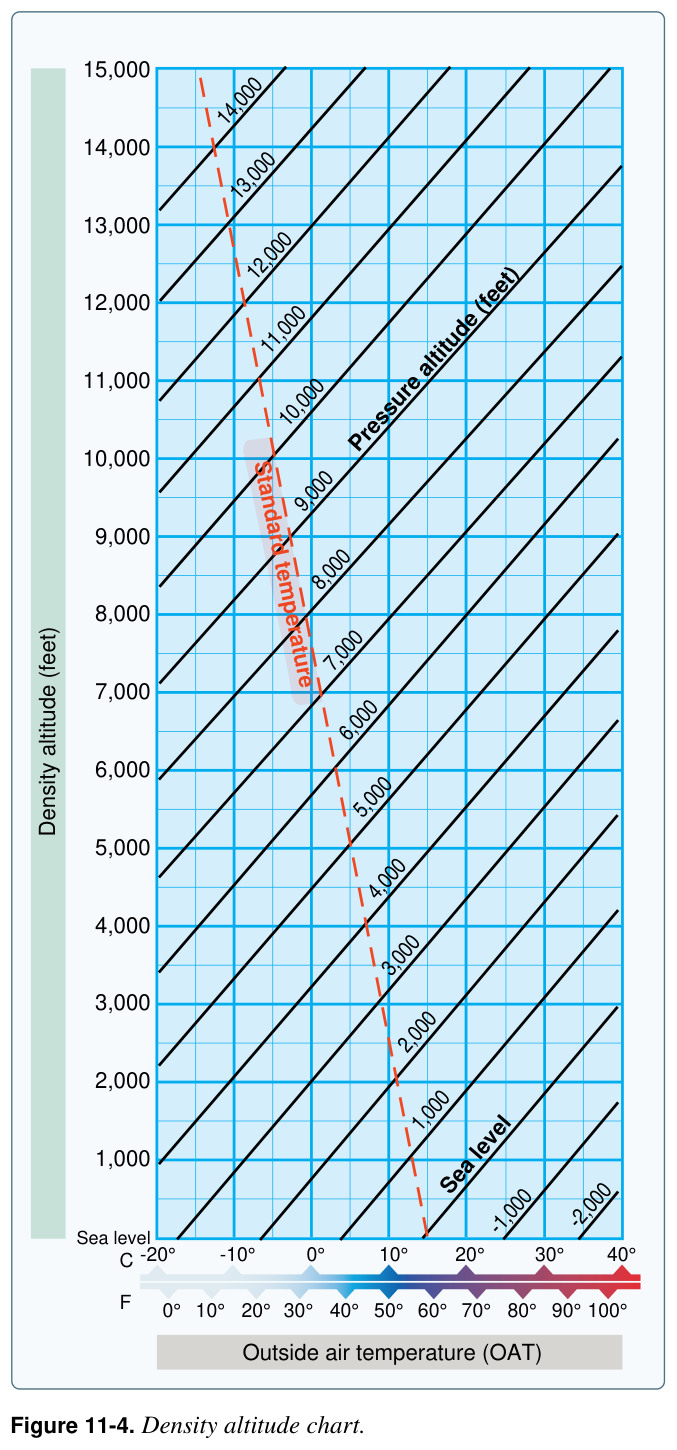
High density altitude means a longer takeoff roll, a weaker climb, and — for the same indicated airspeed — a higher true airspeed (so a faster groundspeed on takeoff and landing). It's the single biggest performance factor, and it's worst exactly where it's dangerous: a hot day at a high-elevation airport.
Why it matters
A DPE might ask
- What is density altitude, and what raises it?
- How does high density altitude affect takeoff, climb, and true airspeed?
Definition
Explanation
The simplified rule is density altitude = pressure altitude + 120 × (current temp − standard temp), where standard temperature is 15 °C at sea level and drops 2 °C per 1,000 feet. It's an approximation — good to about 100 feet — and it ignores humidity (the full formula includes humidity but isn't something you do in your head). It's enough to show how density altitude works and to make a go/no-go call. The calculator below does exactly this and shows every step.
Why it matters
A DPE might ask
- How do you find pressure altitude?
- Walk me through the simplified density-altitude computation.
Definition
Explanation
A heavier airplane needs more runway, climbs worse, and stalls faster. A headwind shortens the takeoff and landing distance while a tailwind lengthens them — always know the wind component. And the runway itself matters: a soft or rough surface, an upslope, or contamination like water, snow, or slush all degrade takeoff acceleration and braking.
| Factor | Effect on performance |
|---|---|
| Density altitude | High, hot, or humid = thinner air = longer takeoff, weaker climb, higher true airspeed. The big one. |
| Weight | Heavier = longer takeoff roll, reduced climb, higher stall speed, longer landing. |
| Wind | A headwind shortens takeoff and landing; a tailwind lengthens them. Always know the wind component. |
| Runway | A soft or rough surface, an upslope, and contamination (water, snow, slush) all hurt takeoff and braking. |
Why it matters
A DPE might ask
- How do weight and wind affect takeoff and landing?
- What runway conditions degrade performance?
Definition
Explanation
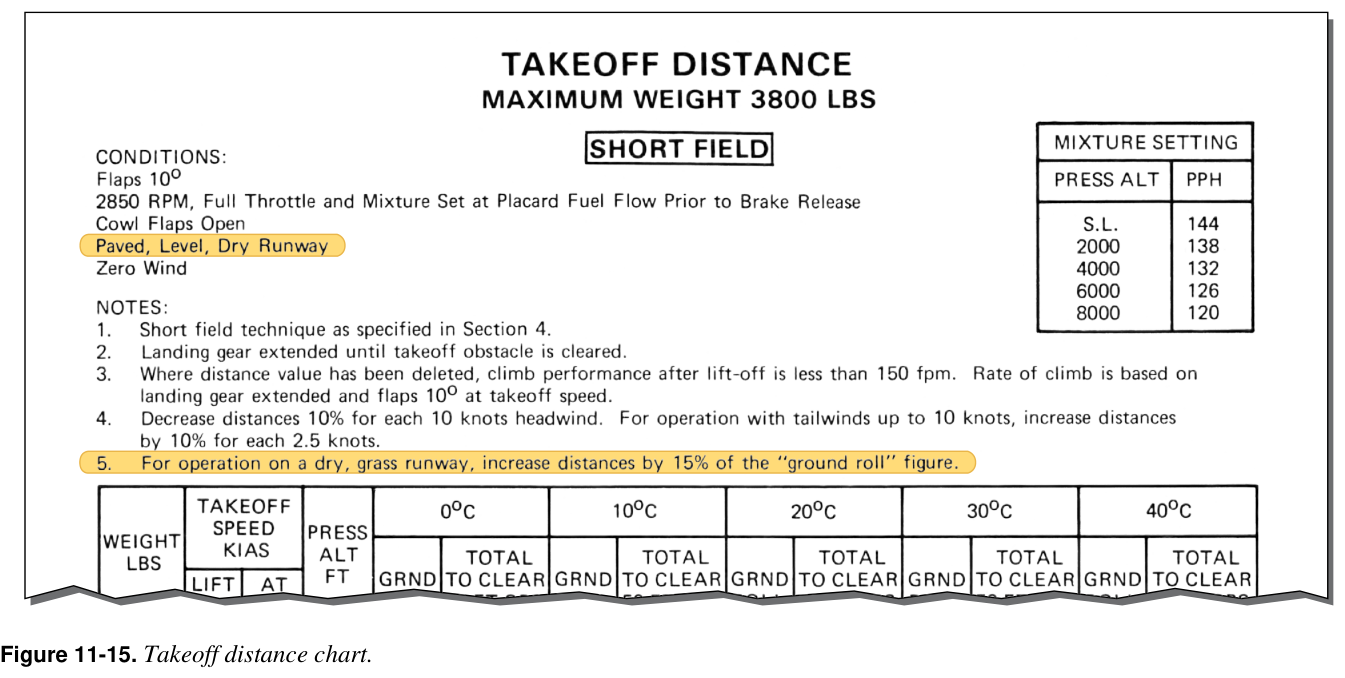
Follow the chart's own lines carefully, and respect the conditions it assumes — usually a paved, level, dry runway and a new airplane flown by a test pilot. Read the total distance to clear a 50-foot obstacle, not just the ground roll, and add a real safety margin to whatever the chart says.
Why it matters
A DPE might ask
- What inputs does a takeoff chart need, and what does it give you?
- Why read to a 50-foot obstacle?
Definition
Explanation
Both Vx and Vy come from your V-speeds. Climb rate shrinks as you go up, until the service ceiling — where the best rate of climb falls to just 100 feet per minute. In cruise, you choose a power setting for best economy or best power, and higher altitudes usually give better range and a higher true airspeed for the same power.
| Climb & cruise | Detail |
|---|---|
| Vx — best angle | Most altitude per unit of distance — use it to clear an obstacle. |
| Vy — best rate | Most altitude per unit of time — use it for the quickest climb to altitude. |
| Service ceiling | Climb rate shrinks with altitude; the service ceiling is where the best rate falls to 100 ft/min. |
| Cruise | Power settings trade speed for fuel — know best-economy vs best-power, and that higher altitude usually means better range and a higher true airspeed. |
Why it matters
A DPE might ask
- Explain Vx versus Vy.
- What is the service ceiling?
Definition
Explanation
Density altitude is the factor that bites hardest at high, hot airports, so that's where careful planning matters most. Always read takeoff and landing distances to the 50-foot obstacle, and treat the book numbers as a best case you pad, not a promise.
| Performance habit | Detail |
|---|---|
| Use the actual conditions | Compute for the day's real density altitude, weight, and wind — not the standard-day book number. |
| Add margin | Book numbers assume a new airplane, a test pilot, and a clean runway. Add a healthy margin. |
| Density altitude bites high & hot | A hot day at a high-elevation airport is where performance planning saves lives. |
| Read to the obstacle | Use the total distance over a 50-ft obstacle, not just the ground roll. |
Why it matters
A classic trap is using the sea-level, standard-day takeoff number on a hot day at a high-elevation airport. The real density altitude can be thousands of feet higher, dramatically lengthening the takeoff roll and flattening the climb. Compute for the actual density altitude, every time.
It's a 35 °C afternoon at a 5,000-ft field. Compared with the sea-level standard-day book number, your takeoff roll will be:
A DPE might ask
- Why plan performance for the actual conditions instead of the book standard day?
- Where does density altitude matter most?