
Runway-Incursion Avoidance & Ground Operations
Definition
Explanation
For a general-aviation pilot, an incursion usually means a pilot deviation: taking a wrong turn while taxiing, crossing a hold-short line without a clearance, or simply losing track of where you are on a complex airport. The hold-short line you learned in the markings lesson is the boundary you're protecting — cross it without authorization and you've had an incursion. This whole lesson is about the habits that keep you on the right side of that line.
| Idea | What it means |
|---|---|
| What it is | A runway incursion is ANY unauthorized aircraft, vehicle, or person on a runway — the #1 ground-safety risk. |
| The boundary | The hold-short line is the edge you protect; crossing it without a clearance is the incursion (see Markings). |
| Most common cause | For GA, usually a pilot deviation — a wrong turn, crossing without a clearance, or losing track of position. |
| The fix | Predictable taxiing, read-backs, and knowing exactly where you are prevent nearly all of them. |
Why it matters
A DPE might ask
- What is a runway incursion?
- What's the most common cause for a GA pilot?
Definition
Explanation
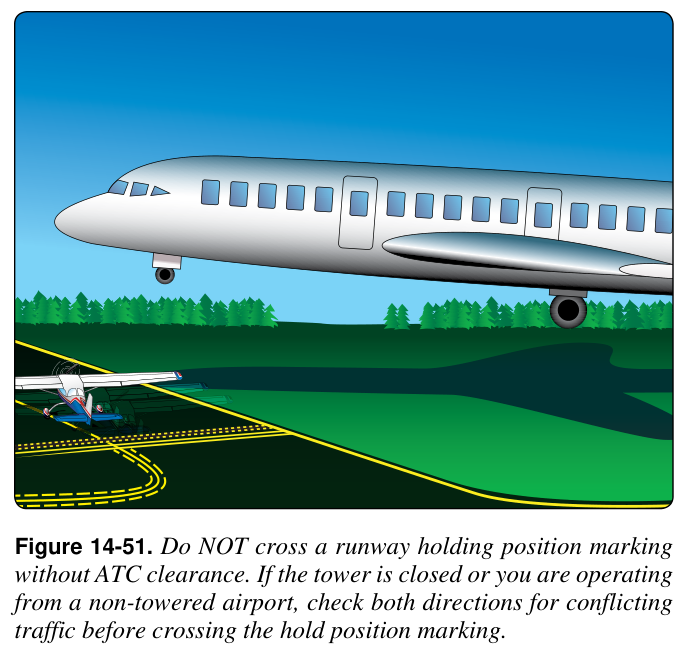
At a towered airport, ATC issues explicit instructions — 'hold short of runway 27' or 'cross runway 27' — and controllers clear you across one runway at a time. Read back every hold-short and crossing instruction, including the runway number (from the Radio Communications lesson). If you're ever holding short and unsure whether you've been cleared, stay put and ask. Never assume.
Why it matters
A DPE might ask
- When may you cross a runway holding-position marking?
- What must you read back, and what do you do if you're unsure?
Definition
Explanation
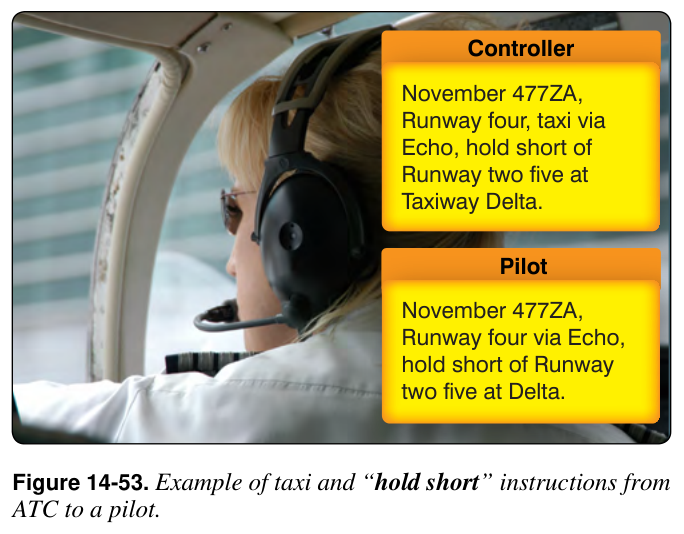
Copy the taxi clearance and read it back, then follow it on the airport diagram, tracking your position the whole way. Keep a sterile cockpit — no non-essential conversation or head-down tasks while the airplane is moving. If you get confused or lose track of where you are, stop or hold and ask ATC for progressive taxi (turn-by-turn directions). And never enter or cross a runway as part of your taxi without a specific clearance.
Why it matters
A DPE might ask
- How do you set yourself up for a safe taxi?
- What do you do if you lose track of your position on the airport?
Definition
Explanation
Hot spots are complex or confusing intersections — where the geometry makes a wrong turn onto a runway easy — and they're marked on airport charts and in the Chart Supplement. Brief them before you taxi. Read the signs and markings (from the Markings lesson) to stay oriented. And where they're installed, runway status lights give you an automatic warning: red Runway Entrance Lights (REL) at a runway entrance, and red Takeoff Hold Lights (THL) at the takeoff position, illuminate on their own when the runway isn't safe. Never cross or roll on a red status light — even if you have a clearance — stop and query ATC.
| Feature | What to do |
|---|---|
| Hot spots | Complex or confusing intersections flagged on charts and the Chart Supplement. Brief them before you taxi. |
| Signs & markings | Read the signs (mandatory red, location black, direction/destination yellow) and markings to stay oriented — drilled next. |
| Runway status lights | Where installed, red REL (runway entrance) and THL (takeoff hold) lights turn on automatically when the runway is unsafe. |
| Never cross on red | Never cross or roll on a red status light — even with a clearance. Stop and query ATC. |
Why it matters
A DPE might ask
- What is a hot spot, and where do you find them?
- What are REL and THL, and what do you do if one is red?
Definition
Explanation
The color tells you the job: mandatory signs are red (a hold-short or no-entry — the one to know cold), location signs are black (where you are), and direction, destination, and information signs are yellow (where things are). Distance-remaining signs are black with a white number. Match them until the color-to-meaning is automatic — because on a busy taxiway you read a sign in a glance, not by puzzling it out.
diagram: sign.gameWhy it matters
A DPE might ask
- What does a red sign mean? A black location sign?
- What are the yellow signs?
Definition
Explanation
You are never required to accept a LAHSO clearance: as pilot in command you may decline it simply by saying 'unable,' and a student pilot should not accept one at all. If you do accept, only do so when the available landing distance — which is published — is adequate for your airplane and the conditions, and land and stop as cleared. When in doubt, decline; a normal full-length landing is always an option.
| LAHSO | Detail |
|---|---|
| What it is | Land And Hold Short Operations — ATC asks you to land and hold short of an intersecting runway or point. |
| You may decline | As PIC you may decline a LAHSO clearance — just say "unable." |
| Students: don't accept | A student pilot should not accept a LAHSO clearance. |
| Available landing distance | Only accept if the available landing distance (published) is adequate for your aircraft and conditions. |
Why it matters
A DPE might ask
- What is LAHSO, and can you decline it?
- Should a student pilot accept a LAHSO clearance?
Definition
Explanation
Plan the taxi and follow it on the diagram; read back every hold-short and crossing instruction with the runway number; keep a sterile cockpit and your eyes outside; treat the hold-short line and any red status light as hard stops; and when you're unsure of your position, stop or hold and ask for progressive taxi rather than guessing. None of it is hard — it's just discipline, done every time.
| Habit | Why it matters |
|---|---|
| Plan the taxi | Write down the clearance and follow it on the airport diagram; know your position at all times. |
| Read back hold-short | Read back every hold-short and crossing instruction with the runway number (see Radio Comms). |
| Sterile cockpit | No distractions while taxiing — heads up, eyes outside. |
| Hard stops | The hold-short line and a red status light are absolutes — never cross without a clearance, never move on red. |
| When unsure, ask | Lost your position? Stop or hold and request progressive taxi — never guess near a runway. |
Why it matters
A common trap is to keep taxiing when you're not sure where you are, hoping to figure it out — right when you're most likely to wander onto a runway. The correct move is the opposite: stop or hold, get oriented, and ask ATC for progressive taxi.
Taxiing at an unfamiliar towered airport, you lose track of your position near a complex intersection. You should:
A DPE might ask
- What are the habits that prevent a runway incursion?
- You're unsure of your taxi position — what do you do?