
Light-Gun Signals & Lost Comms
Definition
Explanation
Run the quick checks — turn the volume up, confirm the right frequency, make sure your headset and mic are plugged in, and check the push-to-talk isn't stuck; try your second radio or the last frequency that worked. Set the transponder to 7600 so ATC knows you're NORDO (no radio). And learn how to answer a controller without words: by day you rock your wings, by night you flash your landing or navigation lights.
| Step | What to do |
|---|---|
| Recognize it | No replies, or a normally busy frequency goes silent. Suspect a lost-comms (NORDO) situation. |
| Quick checks | Volume up, correct frequency, headset/mic plugged in, push-to-talk not stuck; try COM2 or the last frequency that worked. |
| Squawk 7600 | Set the transponder to 7600 so ATC and radar see you're NORDO. |
| Acknowledge by day | Rock your wings to acknowledge a light-gun signal. |
| Acknowledge by night | Flash your landing light or navigation lights to acknowledge. |
Why it matters
A DPE might ask
- Your radio goes quiet — what's your first response?
- How do you acknowledge a controller's light-gun signal?
Definition
Explanation
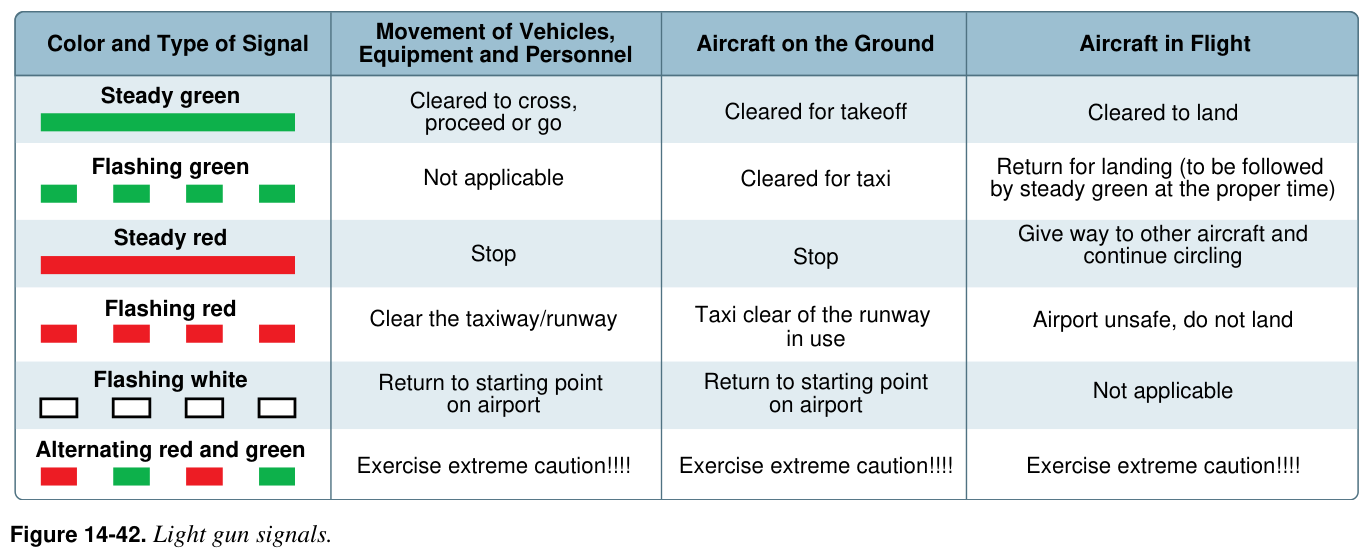
Steady green clears you (takeoff on the ground, landing in the air). Flashing green means cleared to taxi on the ground, or return for landing in the air. Steady red means stop on the ground, or give way and keep circling in the air. Flashing red means taxi clear of the runway on the ground, or the airport is unsafe — do not land — in the air. Flashing white means return to your starting point on the airport (ground only). Alternating red and green means exercise extreme caution.
Why it matters
A DPE might ask
- What does a steady green light mean in flight? On the ground?
- You're on final and get a flashing red — what does it mean and what do you do?
Definition
Explanation
Recognition needs to be automatic, because when you actually see a light gun you won't have time to look it up. Play both boards — in flight and on the ground — until you can match them without hesitating. Notice how the same color means related but different things depending on where you are.
diagram: lightgun.gameWhy it matters
A DPE might ask
- Without looking, what's flashing green in flight?
- What's the difference between steady red on the ground and in the air?
Definition
Explanation
Squawk 7600 so radar tags you as NORDO. Approach the field and watch the tower for a light-gun signal — then comply and acknowledge (rock the wings by day, flash the lights by night). Join the flow carefully, expect a steady or flashing green to land, and keep your eyes outside. This is the VFR light-gun procedure (14 CFR 91.126/91.129); the IFR lost-comms route (91.185) is a separate, later topic.
| At a towered field | What to do |
|---|---|
| Squawk 7600 | Set 7600 on the way in so radar tags you as NORDO. |
| Watch the tower | Look for a light-gun signal from the tower and comply. |
| Acknowledge | Rock the wings (day) or flash the lights (night) to show you got it. |
| Join carefully | Enter the flow, keep your eyes outside, and expect a steady or flashing green to land. |
| It's VFR light-gun | This is the VFR light-gun procedure (91.126/129) — not the IFR lost-comms route (91.185). |
Why it matters
A DPE might ask
- You arrive at a towered field with a dead radio — walk me through it.
- What code do you squawk, and what are you looking for?
Definition
Explanation
Fly the standard pattern: enter on the 45° to the downwind, fly predictable legs, and use the wind indicators to pick the runway. Scan constantly and give way, because others may also be no-radio and no one is announcing for you. Then land normally. The whole non-towered system is built on see-and-avoid, which is exactly what you fall back on.
| At a non-towered field | What to do |
|---|---|
| No radio required | Two-way radio isn't legally required at a non-towered field, so a radio failure isn't an emergency. |
| See and avoid | Fly heads-up: scan constantly and give way — no one is announcing for you. |
| Fly the standard pattern | Enter on the 45° to the downwind and fly a normal, predictable pattern (see Traffic Patterns). |
| Expect NORDO peers | Others may be no-radio too; don't assume anyone hears you or is heard. |
| Land normally | Pick the runway from the wind indicators and land. |
Why it matters
A DPE might ask
- Is a radio required at a non-towered field?
- How does a radio failure change your arrival at a non-towered field?
Definition
Explanation
7500 means unlawful interference (a hijack). 7600 means lost communications. 7700 means a general emergency. A common memory hook: '7500 taken alive, 7600 nix comms, 7700 going to heaven.' And 121.5 is the emergency 'guard' frequency you can call on (it's also what an ELT transmits on — from the Regulations module). Your normal VFR code, by contrast, is 1200.
| Code | Meaning |
|---|---|
| 7500 | Unlawful interference (hijack) — "taken alive." |
| 7600 | Lost communications — "nix comms." |
| 7700 | Emergency — "going to heaven." |
| 121.5 | The emergency voice "guard" frequency (also what an ELT transmits on — see Regulations). |
| 1200 | The standard VFR code (not an emergency) — your normal squawk. |
Why it matters
A common mix-up is which emergency code to squawk. If only your radio fails, that's lost communications — 7600 — not the general emergency code 7700. Keep them straight: 7600 for a dead radio, 7700 for an actual emergency.
Your radio quits en route but everything else is fine. What do you squawk?
A DPE might ask
- What do 7500, 7600, and 7700 mean?
- Radio fails but nothing else is wrong — which code?