
Airport Markings, Signs & Lighting
Definition
Explanation
Two special cases matter. A displaced threshold (a solid line across the runway with arrows leading up to it) means the pavement before it is usable for taxi and takeoff, but you must land beyond the displaced threshold. A blast pad or stopway is marked with yellow chevrons — it looks like runway but is not for taxiing, takeoff, or landing.
image: airport_runway_markingsWhy it matters
A DPE might ask
- What does the runway number tell you?
- What does a displaced threshold mean? What are the chevrons?
Definition
Explanation
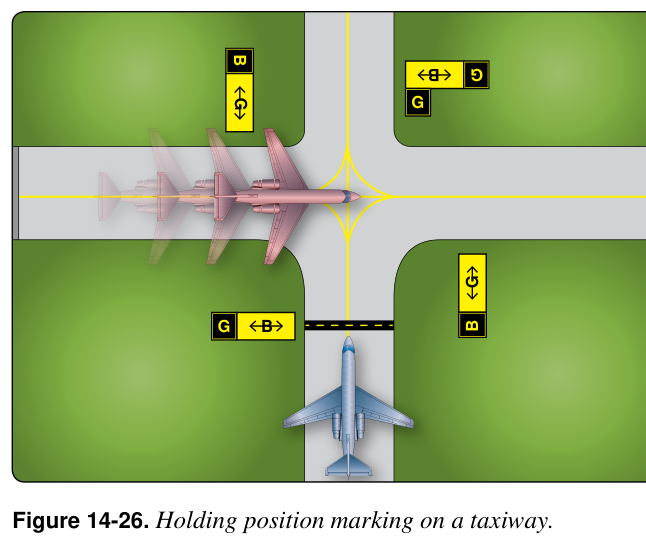
You approach the hold-short marking from the solid-line side. You stop at the solid lines and do not cross onto the runway until you have a clearance (at a towered field) or you've confirmed the runway and approach are clear (at a non-towered field). Crossing from the dashed side means you're leaving the runway, and no hold-short applies.
Why it matters
A DPE might ask
- Describe the runway holding-position marking.
- From which side do you stop, and when may you cross?
Definition
Explanation
Location signs (black background, yellow text) tell you where you are. Direction and destination signs (yellow background, black text and arrows) tell you where a taxiway leads. Information signs (also yellow) carry frequencies and advisories. And runway distance-remaining signs (black background, white number) count down the thousands of feet of runway left. Red = mandatory = stop.
| Sign | Color & meaning |
|---|---|
| Mandatory | Red background, white text — a hold-short or no-entry instruction (e.g., "15-33" at a runway hold). Never cross without a clearance. |
| Location | Black background, yellow text/border — tells you where you are (the taxiway or runway you're on). |
| Direction | Yellow background, black text and arrows — where a taxiway leads at an intersection. |
| Destination | Yellow background, black text — the way to a runway, ramp, or FBO. |
| Information | Yellow background, black text — frequencies, noise abatement, and other advisories. |
| Distance remaining | Black background, white number — thousands of feet of runway remaining (a "3" = 3,000 ft left). |
Why it matters
A DPE might ask
- What does a red sign mean? A black location sign?
- What does a runway distance-remaining sign tell you?
Definition
Explanation
Runway edge lights are white, turning amber over the last part of the runway as a caution zone; threshold lights are green as you approach and red facing the far end. Runway End Identifier Lights (REIL) flash to make the approach end obvious. Taxiways use blue edge lights (and green centerline lights where installed). At many non-towered fields the lighting is pilot-controlled — you key the mic on the CTAF to turn it up.
| Lighting | What it tells you |
|---|---|
| Rotating beacon | White-and-green flashes mark a lighted civil airport. On in the daytime often means the field is below VFR (IFR conditions). |
| Runway edge lights | White, turning amber over the last 2,000 ft (or half the runway) as a caution zone. |
| Threshold lights | Green as you approach the landing threshold; red facing the far (departure) end. |
| REIL | Runway End Identifier Lights — synchronized flashers that make the approach end easy to pick out. |
| Taxiway lights | Blue edge lights; where installed, green centerline lights. |
| Pilot-controlled | At many non-towered fields you key the mic on the CTAF (3, 5, or 7 clicks) to bring the lights up. |
Why it matters
A DPE might ask
- What do the beacon colors mean, and what does a daytime beacon suggest?
- How do you use pilot-controlled lighting?
Definition
Explanation
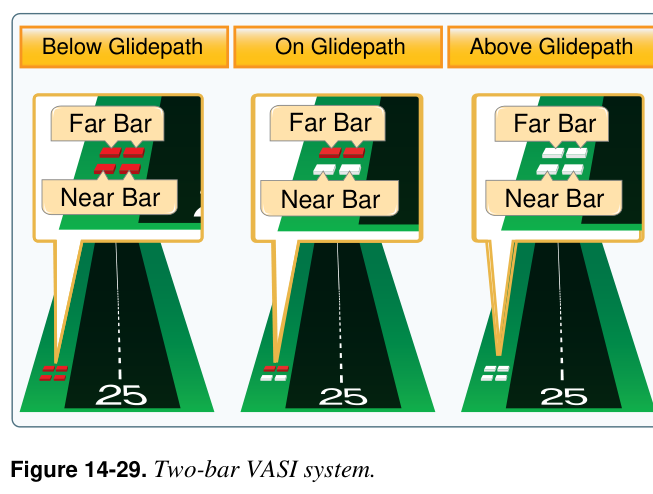
On a two-bar VASI, red over white means you're on the glidepath — 'red over white, you're all right.' White over white means you're too high; red over red means you're too low ('red over red, you're dead'). A PAPI reads the same way by count: more white lights = high, more red = low, two-and-two = on path. Fly the glidepath down to the runway.
Why it matters
A DPE might ask
- Interpret a two-bar VASI: red over white, white over white, red over red.
- How does a PAPI show your position on the glidepath?
Definition
Explanation
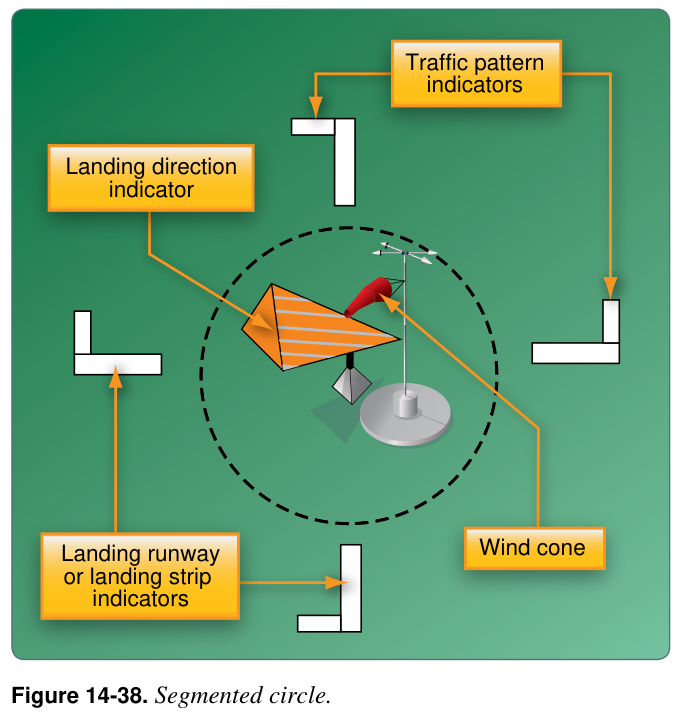
The wind sock points where the wind is going to and stands out stiffer in a stronger wind; you take off and land into the wind, so it tells you the active runway. Segmented-circle indicators can also show a non-standard (right-hand) pattern. And the safety bottom line for the whole lesson: the hold-short line is the one marking you never cross without a clearance — that's where runway incursions happen.
Why it matters
A common mix-up is reading the wind sock backwards. The sock points in the direction the wind is blowing TOWARD; since you take off and land INTO the wind, you use the runway whose numbers you'd be heading toward as you face into the wind — roughly opposite the way the sock points.
The wind sock points toward the south (the wind is from the north). Which runway is favored?
A DPE might ask
- How does the wind sock tell you the runway in use?
- Where do runway incursions happen, and how do you avoid one?