
Traffic Patterns & Non-Towered Operations
Definition
Explanation
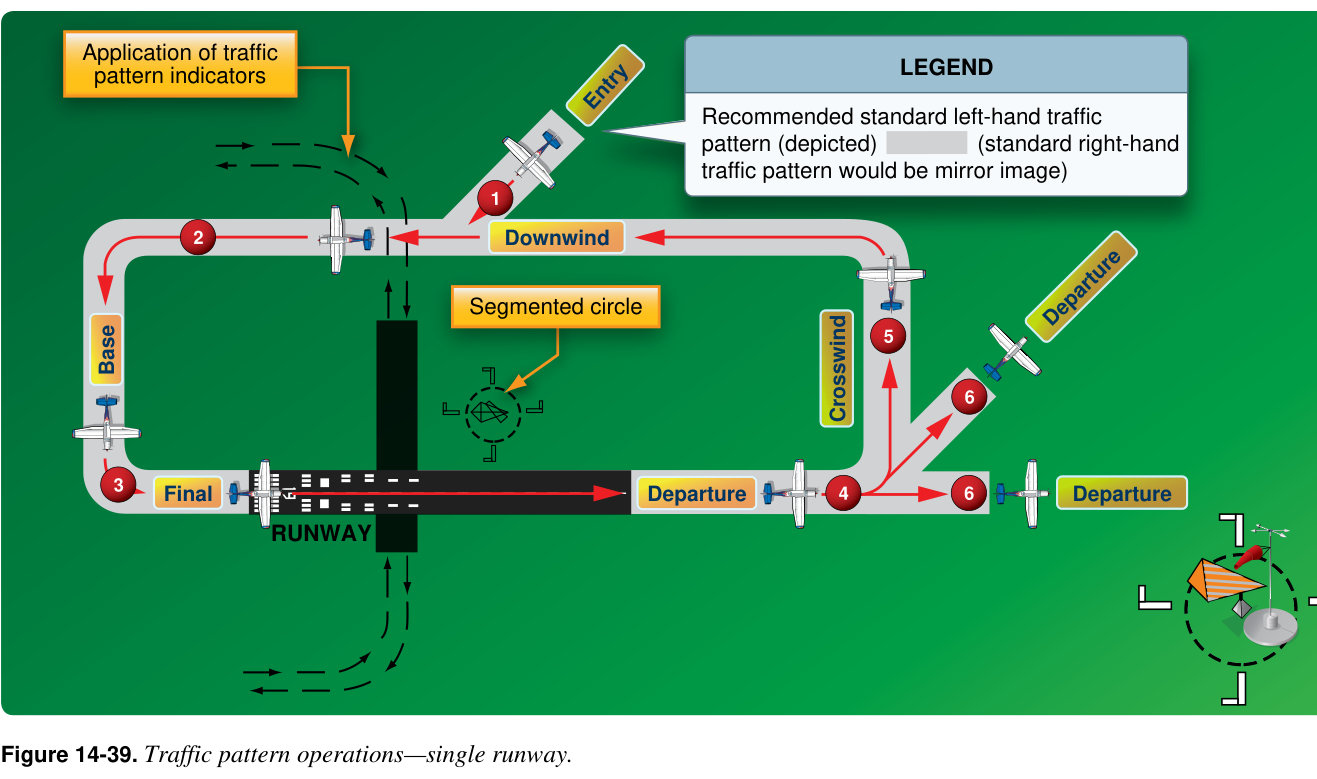
The standard pattern is left-hand: every turn is to the left. A right-hand pattern (all right turns) is the mirror image, used where terrain, noise, or airspace requires it — it's published in the Chart Supplement and shown by the segmented circle. Downwind is flown parallel to the runway, opposite the landing direction; you turn base, then final, and land into the wind.
Why it matters
A DPE might ask
- Name the legs of the traffic pattern.
- What is a standard pattern, and how do you know if a runway uses a right-hand pattern?
Definition
Explanation
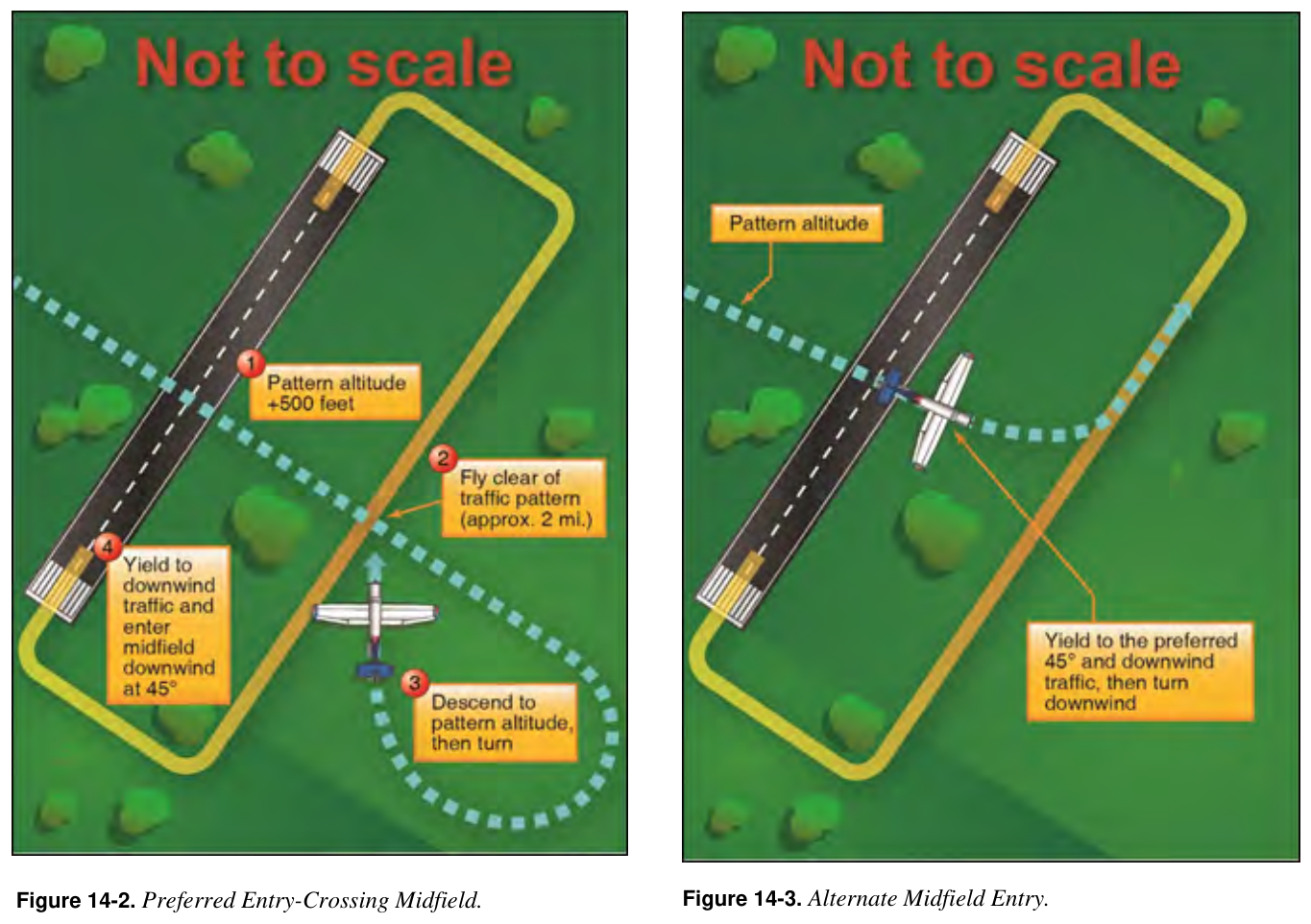
If you're already on the pattern side, join the 45° to the midfield downwind at pattern altitude. If you're on the wrong side, cross over midfield to reach the pattern side (next slide). The exception that overrides everything: at a field with active skydiving or parachute jumping, never overfly midfield — maneuver around to enter on the 45° no matter which side you came from. Always check the Chart Supplement and NOTAMs first for a right-hand pattern, a non-standard altitude, or special activity.
| Situation | How to enter |
|---|---|
| Pattern (correct) side | Join the 45° to the midfield downwind at pattern altitude. The simplest entry — you're already on the correct side. |
| Wrong side of the runway | Cross over midfield above pattern altitude, fly clear, descend to pattern altitude, then join the 45° to the downwind (next slide). |
| Skydiving / parachute ops | Never overfly midfield — jumpers may be descending overhead. Maneuver around to enter on the 45°, whichever side you came from, even if it costs time. |
| Before you commit | Check the Chart Supplement / NOTAMs for a right-hand pattern, a non-standard pattern altitude, or special activity (parachuting, gliders, ultralights). |
Why it matters
A DPE might ask
- How do you decide how to enter a non-towered pattern?
- How does active skydiving change your entry?
Definition
Explanation
Cross midfield about 500 feet above pattern altitude, continue far enough to be clear of the pattern (roughly 2 miles), descend to pattern altitude on the upwind side, then turn back and join the 45° to the midfield downwind, yielding to established traffic. The critical exception: if skydiving or parachute jumping is active, do NOT overfly the field — jumpers fall through the exact altitudes you'd cross. Stay clear and maneuver around to enter on the 45°, even though it takes longer.
Why it matters
A common trap is treating 'cross midfield to enter' as a rule that always applies. At a field with active parachute operations, overflying midfield puts you where jumpers are descending. The right move is to give up the shortcut and maneuver around to the 45° entry.
You're approaching a non-towered field from the wrong side, and the Chart Supplement shows active parachute jumping. How do you enter?
A DPE might ask
- Walk me through a crossing-midfield entry from the wrong side.
- Why — and how — do you change that entry at a skydiving field?
Definition
Explanation
The key position reports are: inbound about 10 miles out, entering the downwind, turning base, turning final, and clear of the runway after landing — plus before you taxi and before you depart. Each call lets everyone else update their picture of who's where. The report gives your position and intentions; it never replaces looking outside.
| When you call | What you're telling others |
|---|---|
| Inbound (~10 mi out) | Where you are and that you're joining — gives pattern traffic time to spot you. |
| Entering downwind | You're now in the pattern on the downwind for the runway in use. |
| Turning base | You're leaving the downwind for base, so others can sequence. |
| Turning final | You're on final to land — the key call for anyone near the runway. |
| Clear of the runway | You're off the runway and it's available again. |
| Before taxi & departure | You're about to taxi/take off, and which way you'll depart. |
Why it matters
A DPE might ask
- At what points in the pattern do you self-announce?
- What is the purpose of a position report at a non-towered field?
Definition
Explanation
An aircraft on final or landing has the right of way over aircraft in flight or on the surface — but can't use it to cut in front of or overtake another already on final. When two are approaching to land, the lower has the right of way, with the same no-cutting-in caveat. If you overtake someone, pass well to the right. When two aircraft converge in flight, the one on the other's right has the right of way. An aircraft in distress has the right of way over everyone.
| Situation | Who has the right of way |
|---|---|
| Landing / on final | The aircraft on final approach (or landing) has it over aircraft in flight or on the surface — but may NOT use it to cut in front of another already on final. |
| Two aircraft on final | The lower aircraft has it — but must not cut in front of or overtake the one ahead. |
| Overtaking | The aircraft ahead has it; the overtaking aircraft passes well to the RIGHT and stays clear. |
| Converging in flight | The aircraft on the other's RIGHT has it. |
| Distress / category | An aircraft in distress has the right of way over all; among categories the less-maneuverable is given way (balloon, then glider, then powered). |
Why it matters
A DPE might ask
- Who has the right of way on final approach?
- Two aircraft converge at the same altitude — who gives way?
Definition
Explanation
Climb on the runway heading and don't turn crosswind until you're beyond the departure end of the runway and within 300 feet of pattern altitude. To leave the pattern, either continue straight out, or make a 45° turn in the direction of the pattern (to the left for a left-hand pattern) once you're beyond the departure end and at pattern altitude. Climbing straight ahead first keeps you clear of aircraft turning crosswind behind you.
Why it matters
A DPE might ask
- When may you first turn crosswind after takeoff?
- What are the two standard ways to depart a non-towered pattern?
Definition
Explanation
Fly the published pattern — standard left-hand at about 1,000 feet AGL unless the Chart Supplement or segmented circle says otherwise. Expect NORDO (no-radio) aircraft, so treat your radio calls as a supplement to your eyes, never a substitute. Check the wind indicators before you join, self-announce your positions, and clear every turn. The wrong-way pattern and the head-down pilot are the classic setups for a pattern mid-air.
| Habit | Why it matters |
|---|---|
| Fly the published pattern | Standard is left-hand at ~1,000 ft AGL unless the Chart Supplement / segmented circle says otherwise. A wrong-way pattern is a classic mid-air setup. |
| Expect NORDO traffic | Some aircraft have no radio (or the wrong frequency). Calls supplement your eyes — they never replace see-and-avoid. |
| Check the wind first | Read the wind indicators (segmented circle / sock — see the markings lesson) to pick the runway in use before you join. |
| Announce your positions | Self-announce on the CTAF so others can build a picture of the pattern (the where is this lesson; the words are next). |
| See and avoid | No one is separating you. Clear every turn, scan the pattern, and never assume the other pilot sees you. |
Why it matters
A DPE might ask
- What makes a non-towered pattern safe with no controller?
- Why can't you rely on the radio for separation?