
Risk management: PAVE + the risk matrix
Definition
Explanation
Hazard is the thing; risk is how likely and how bad. You identify, assess, then mitigate — every flight.
| Idea | What it means |
|---|---|
| Hazard | A condition that could cause harm — a low ceiling, a short runway, a tired pilot. |
| Risk | How LIKELY that hazard is to hurt you, and how BAD it would be. |
| Manage it in 3 steps | Identify (PAVE) → Assess (the matrix) → Mitigate (lower it, or don’t go). |
| Sound familiar? | It’s the 3P loop from M8.1 — Perceive, Process, Perform — with real tools. |
Why it matters
Confusing the hazard with the risk — a low ceiling is a hazard; the risk is how likely and how bad it makes the flight.
The three steps of risk management are:
Definition
Explanation
Four buckets of risk. Walk all four and you’ve surfaced almost everything that could bite.
| PAVE | The bucket of hazards |
|---|---|
| P — Pilot | You: fitness, currency, and experience for THIS flight. |
| A — Aircraft | The machine: airworthiness, fuel, equipment, performance. |
| V — enVironment | The outside world: weather, terrain, airspace, day/night, the airport. |
| E — External pressures | The push to go: schedules, passengers, get-there-itis. |
Why it matters
Checking only the airplane and the weather — and forgetting that YOU and the pressure to go are hazards too.
In PAVE, the ‘V’ stands for:
Mnemonic
- Pilot — fitness, currency, experience
- Aircraft — airworthiness, fuel, equipment, performance
- enVironment — weather, terrain, airspace, day/night
- External pressures — schedules, passengers, get-there-itis
Four sources of risk — run all four before every flight.
Definition
Explanation
Each bucket has a handful of usual suspects. The external-pressure ones are the hardest to admit.
| Bucket | Real-world hazards to check |
|---|---|
| Pilot | IMSAFE fitness, currency, recent experience, night/IMC readiness (in depth: M8.4). |
| Aircraft | Airworthy + required equipment, fuel plus reserves, performance for the density altitude and runway. |
| enVironment | Ceilings and visibility, wind and crosswind, terrain, airspace, day vs. night. |
| External pressures | Get-there-itis, a waiting passenger, a schedule — the push that feeds hazardous attitudes (M8.2). |
Why it matters
Treating external pressure as harmless because it isn’t about the airplane — it’s exactly what feeds get-there-itis.
A passenger who MUST be somewhere for a meeting is which PAVE hazard?
Definition
Explanation
Two questions — how likely, how bad — land you in one colored cell that tells you how much the hazard matters.
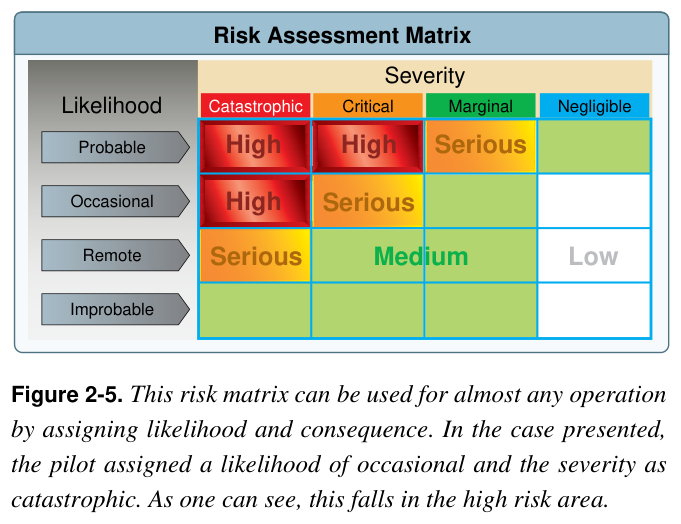
Why it matters
Judging a hazard on severity alone (or likelihood alone) — risk is the two together.
A hazard that is Remote in likelihood but Catastrophic in severity rates as what risk level?
Definition
Explanation
Eliminate, reduce, or accept — and if none gets you to acceptable, you don’t go.
| Move | What it means — example |
|---|---|
| Eliminate | Remove the hazard entirely — leave the extra bag, wait for daylight. |
| Reduce | Lower the risk — delay for better weather, add fuel, bring an instructor, pick a longer runway. |
| Accept | Only when it’s already Low — and stay alert. |
| Can’t get it down? | Then it’s a no-go. Personal minimums (M8.4) are your lines drawn ahead of time. |
Why it matters
Seeing a High risk and launching anyway because of the schedule — High means mitigate or don’t go.
You assess a hazard as High risk. The best response is:
Definition
Explanation
Risk management is the engine of the 3P loop; the rest of the module sharpens its inputs.
| The tool | The step it serves / where it connects |
|---|---|
| PAVE + matrix + mitigate | The real tools that make the 3P loop (M8.1) work. |
| Honest inputs | Hazardous attitudes (M8.2) can corrupt what you feed them. |
| M8.4 — IMSAFE | Drills into the Pilot bucket + sets your personal minimums. |
| M8.5 — SRM | Using every resource to manage workload once airborne. |
Why it matters
Believing risk management ends once you’ve decided to go — it continues as conditions change.
Risk management is best described as: