
Vision, night flying & scanning
Definition
Explanation
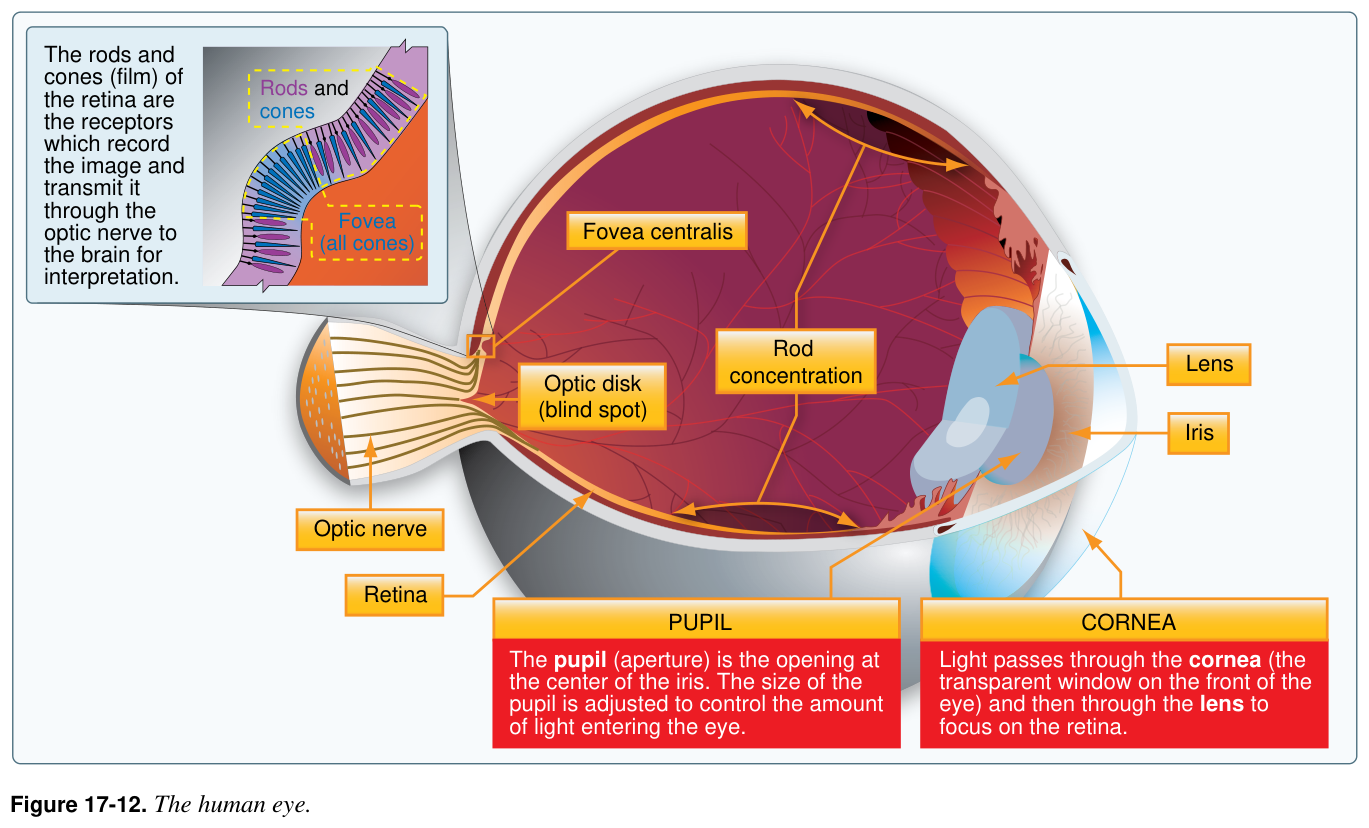
The retina has cones (center, color and detail, need light) and rods (edges, dim light and motion, no color), plus a blind spot where the optic nerve exits.
Why it matters
Assuming the eye works the same by day and by night — the sensor you rely on completely changes.
Which part of the retina gives the sharpest, color, daytime vision?
Definition
Explanation
Rods give night vision, take ≈30 minutes to dark-adapt, and are reset by a single bright light; hypoxia and CO degrade night vision early.
| Sensor | Where / light / what it sees / adaptation |
|---|---|
| Cones | Center (the fovea) — need good light — give color and sharp detail — adapt quickly. |
| Rods | Around the edges — work in dim light — see motion and shades of grey, no color — take ≈30 min to dark-adapt. |
| Dark adaptation | Full night vision takes about 30 minutes; a single bright white light resets it in an instant. |
| Protect it | Dim or red cockpit lighting, avoid glare; hypoxia and carbon monoxide degrade night vision first (M9.1 · M9.4). |
Why it matters
Stepping from a bright hangar into the dark and taking off immediately — your rods aren’t adapted.
You step from a bright hangar into a dark night and take off at once. The risk is:
Definition
Explanation
At night the fovea is a central blind spot; look ≈10° off to the side and keep the eyes moving to keep a dim object in view.
| Night-vision technique | Why / how |
|---|---|
| The night blind spot | The fovea is cone-only — straight ahead is a blind spot in the dark, so a dim object vanishes when you look right at it. |
| Off-center viewing | Look about 10° to the side so the image falls on the rods. |
| Keep scanning | Rods fade if you fixate — keep the eyes moving in slow steps. |
| By day | The cone-rich fovea is exactly what you aim at a target; off-center is a night technique only. |
Why it matters
Staring straight at a dim object at night — that places it on the fovea’s night blind spot, where it vanishes.
At night a dim light vanishes when you look straight at it. You should:
Definition
Explanation
Move the eyes in small steps and pause to focus; a continuous pan sees little. Empty-field myopia relaxes focus to a few feet — refocus on something distant.
| Scanning rule | What to do |
|---|---|
| Stop to focus | The eye only focuses when it is still — a smooth continuous sweep sees almost nothing. |
| Small steps | Move in ≈10° blocks, pausing about a second on each, across the whole windscreen. |
| Empty-field myopia | Nothing to focus on (haze, empty sky)? The eye relaxes to a few feet — refocus on a distant object or your wingtip. |
| Eyes outside | In the pattern and other busy phases, keep the scan outside — not fixated head-down. |
Why it matters
Sweeping the sky in one smooth motion — the eye can’t focus while moving, so you see almost nothing.
The most effective way to scan for traffic is to:
Definition
Explanation
No relative motion plus increasing size means a collision course. Clear your blind spots, clear before maneuvering, and scan early — react time is short.
| See and avoid | The point |
|---|---|
| Constant bearing = collision | Traffic that stays in one spot on your windscreen and grows larger is converging — if it isn’t moving, it’s a threat. |
| Aircraft blind spots | A high wing hides traffic in climbs and turns (raise the wing, clear before turning); a low wing hides traffic below in descents. |
| Clear before maneuvering | Gentle clearing turns before slow flight, stalls, or steep turns. |
| Limited time | About 12.5 seconds from seeing to avoiding — scan early; risk is highest near the pattern, over NAVAIDs, and at converging points. |
Why it matters
Assuming traffic that isn’t moving in the windscreen is no factor — that is exactly the collision-course cue.
Another aircraft stays in the same spot on your windscreen and is slowly getting bigger. This means:
Definition
Explanation
Cones for day, rods for night, off-center viewing for the night blind spot, and a stop-and-step scan for traffic — then on to the other aeromedical factors.
| Recap / what’s next | The point |
|---|---|
| Rods vs cones | Cones for daytime detail and color; rods for night and motion. |
| Look beside it | At night, off-center viewing beats staring — the center of your vision is a blind spot. |
| Stop-and-step scan | Focus only when the eyes are still; watch for the no-relative-motion threat. |
| M9.4 — Other factors | Ear/sinus block, carbon monoxide, motion sickness, dehydration, and diving before flight. |
Why it matters
Thinking a good scan is a smooth sweep — it’s a series of small stops watching for the no-relative-motion threat.
The single best way to spot converging traffic is: